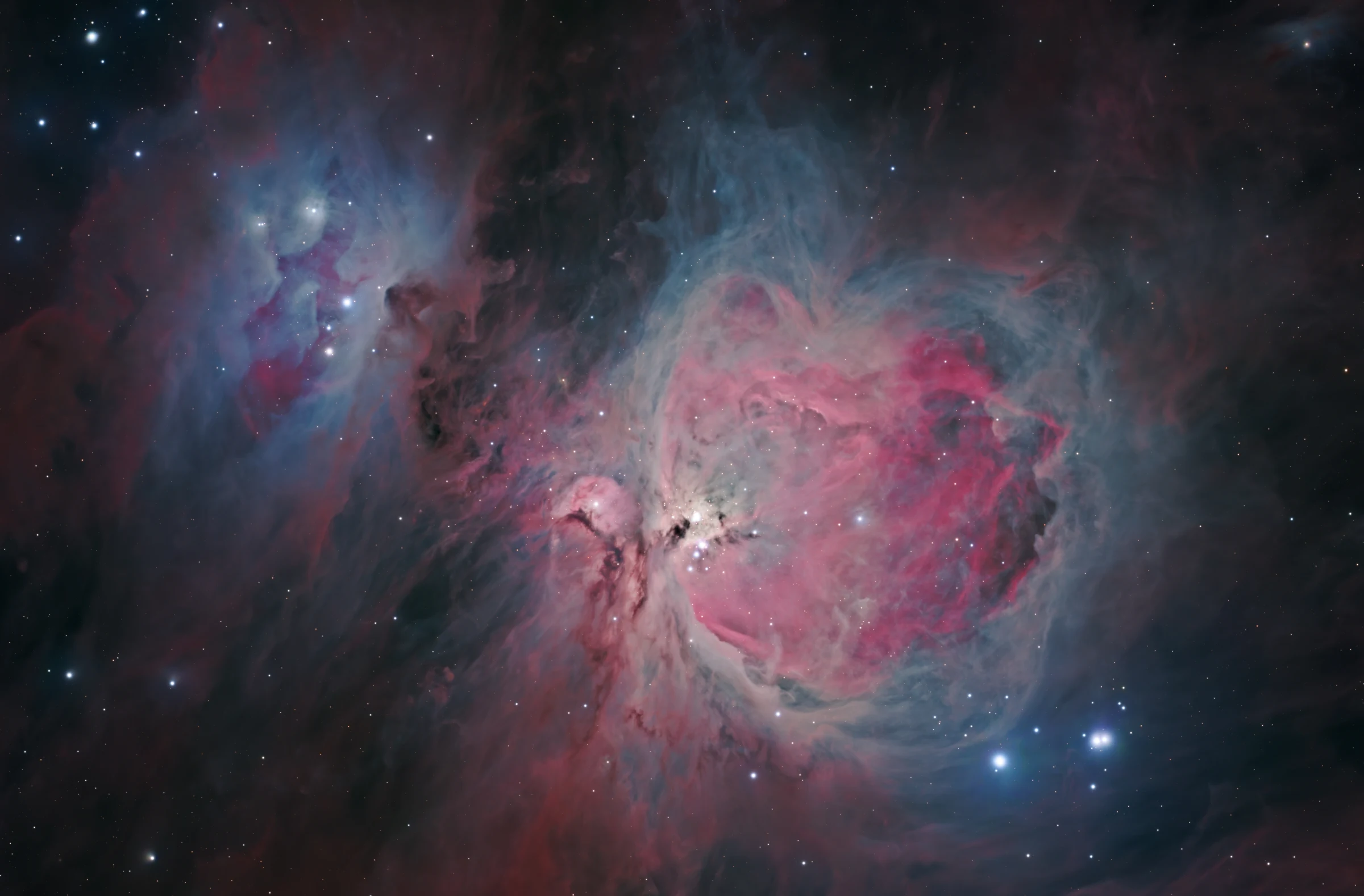
LRGB
M 42 – The Great Orion Nebula
November 2025
Messier 42 (NGC 1976), widely known as the Orion Nebula, is the closest massive star-forming region to Earth, located roughly 1,350 light-years away within the Orion Molecular Cloud. Its luminous core is powered by the young Trapezium Cluster, whose O-type stars carve a bright cavity in the surrounding H II region. Spectroscopic surveys from NASA and ESA show that the nebula's emission is dominated by hydrogen recombination radiation, with layers of ionized oxygen and sulfur tracing shocks, flows, and photodissociation fronts throughout the cloud (O’Dell et al., The Orion Nebula, 2001; NASA/ESA HST Orion Project). Its proximity and complexity make M42 a benchmark object for studies of stellar birth and protoplanetary disk evolution.
Target Information
- Catalog ID
- The Great Orion Nebula★M 42
- Common Name
- Orion Nebula
- Constellation
- Orion
- Object Type
- Emission Nebula
- RA
- 5h 35m 1s
- Dec
- -5° 19′ 11″
- Field of View
- 1.83° × 1.20°
Acquisition Data
10h 13m total| Filter | Frames | Exp | Subtotal |
|---|---|---|---|
| Lum | 60 | 180s | 3h |
| R | 30 | 180s | 1h 30m |
| G | 30 | 180s | 1h 30m |
| B | 31 | 180s | 1h 33m |
| Hα | 24 | 300s | 2h |
| L, R, G, B | 160 | 15s | 40m |
Equipment
Starfront - Redcat 91 · Starfront Observatories · Bortle 1
Telescope
Camera
Mount
Filters
Accessories
Guiding Optic
Guiding Camera