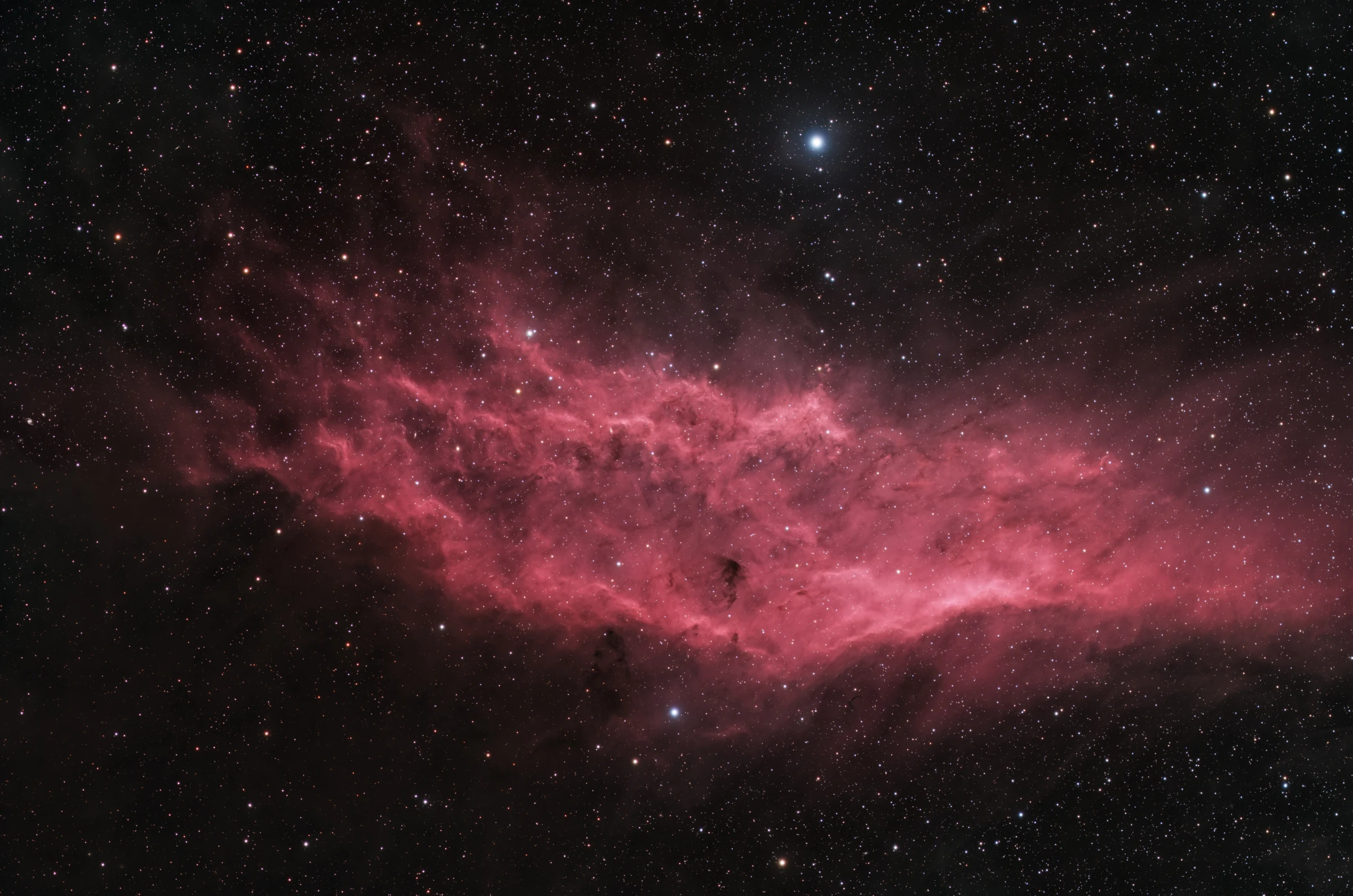
NGC 1499
NGC 1499 - California Nebula
October 2025
NGC 1499, commonly called the California Nebula for its resemblance to the outline of the U.S. state, is a large H II emission region in the constellation Perseus, located roughly 1,000 light-years from Earth. The nebula spans over 2.5 degrees of sky—more than five times the width of the Moon—and is among the largest hydrogen emission structures visible in wide-field deep-sky imaging. The illumination of NGC 1499 is dominated by the hot O-type star ξ Persei (Menkib). Although the star appears several degrees away from the nebula on the sky, its ultraviolet radiation is responsible for exciting the hydrogen gas that makes the California Nebula glow so prominently in Hα. Early photographic surveys from the mid-20th century, including the Palomar Observatory Sky Survey, recorded NGC 1499 as a bright, elongated patch of nebulosity with a sharply defined western edge and a much softer eastern side. Its great size allowed it to be recognized well before narrowband filters were commonly used, and it has since become one of the most frequently imaged emission nebulae of the northern Milky Way. This composition captures the full length of NGC 1499, revealing the nebula’s bright western ionization front, its broad expanse of softer hydrogen emission to the east, and a stretch of the surrounding Perseus molecular cloud complex. The wide field also includes several distant background galaxies, providing a deep extragalactic backdrop to the emission structure.
Target Information
- Catalog ID
- NGC 1499★
- Common Name
- California Nebula
- Constellation
- Perseus
- Object Type
- Emission Nebula
- RA
- 3h 59m 37s
- Dec
- +36° 30′ 49″
- Field of View
- 2.95° × 1.96°
Acquisition Data
11h 41m total| Filter | Frames | Exp | Subtotal |
|---|---|---|---|
| Lum | 182 | 90s | 4h 33m |
| R | 61 | 90s | 1h 31m |
| G | 62 | 90s | 1h 33m |
| B | 61 | 240s | 4h 4m |
Equipment
Starfront - Redcat 91 · Starfront Observatories · Bortle 1
Telescope
Camera
Mount
Filters
Accessories
Guiding Optic
Guiding Camera