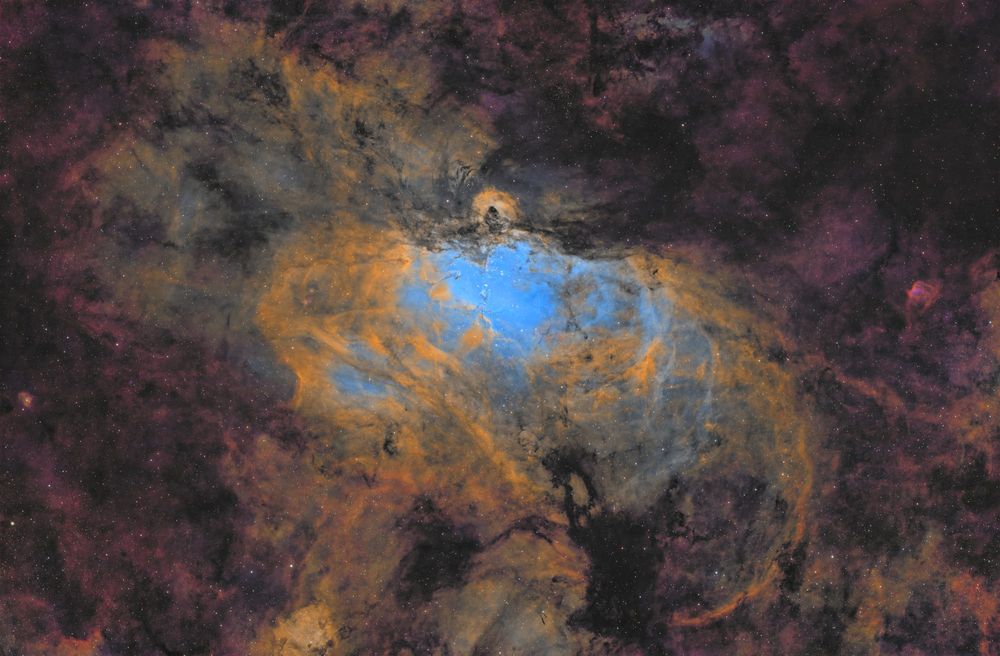
Ask anyone to picture the Eagle Nebula and they'll picture the Pillars of Creation, three dusty fingers made famous by Hubble in 1995. But those pillars are a detail. M16 is a sprawling stellar nursery some 5,700 light-years away in Serpens, a cavity of glowing gas blown open by the young cluster NGC 6611, whose fierce ultraviolet light is simultaneously sculpting the nebula and eating it alive.
This is the framing you almost never see: the whole Eagle at once. At roughly 3° × 2°, the RedCat 91 field pulls back far enough that the famous pillars shrink to a speck at the center of a luminous blue cavity, and another story emerges: an enormous shell of hydrogen wrapping the entire complex, dark rivers of dust pouring in from the north, and a Milky Way background smoldering in sulfur red from edge to edge.
The Field
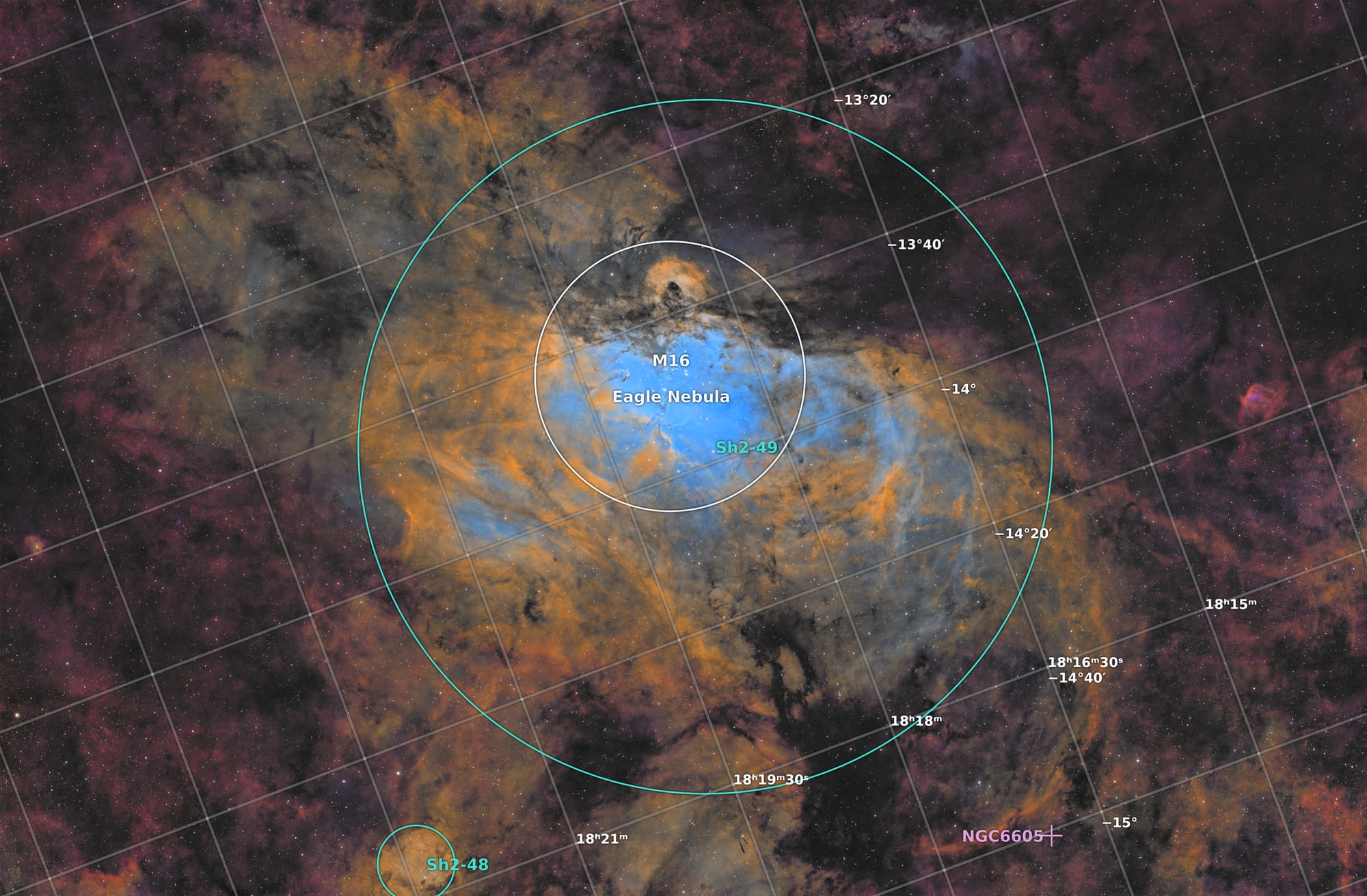
Start at the middle. That blue glow is the heart of M16, a bubble of doubly ionized oxygen kept lit by NGC 6611, the young cluster whose hottest members formed only two or three million years ago. The pillars themselves sit dead center, silhouetted against the blue like cracks in a lit window. Below and right of the cavity, a huge dark trunk hooks up into the glow, and above it a shelf of black dust arches clean across the nebula's crown.
Everything beyond that is what the wide field earns you. The golden shell, hydrogen laced with sulfur, sweeps outward in layered ribbons, brightest along the western side and trailing off into a vast arc that closes around the lower right of the frame. The maroon backdrop isn't empty either: it's the dust-reddened Serpens Cauda star cloud, dotted with a couple of compact emission patches near the left and right edges of the frame.
The Pillars, Cut Down to Size
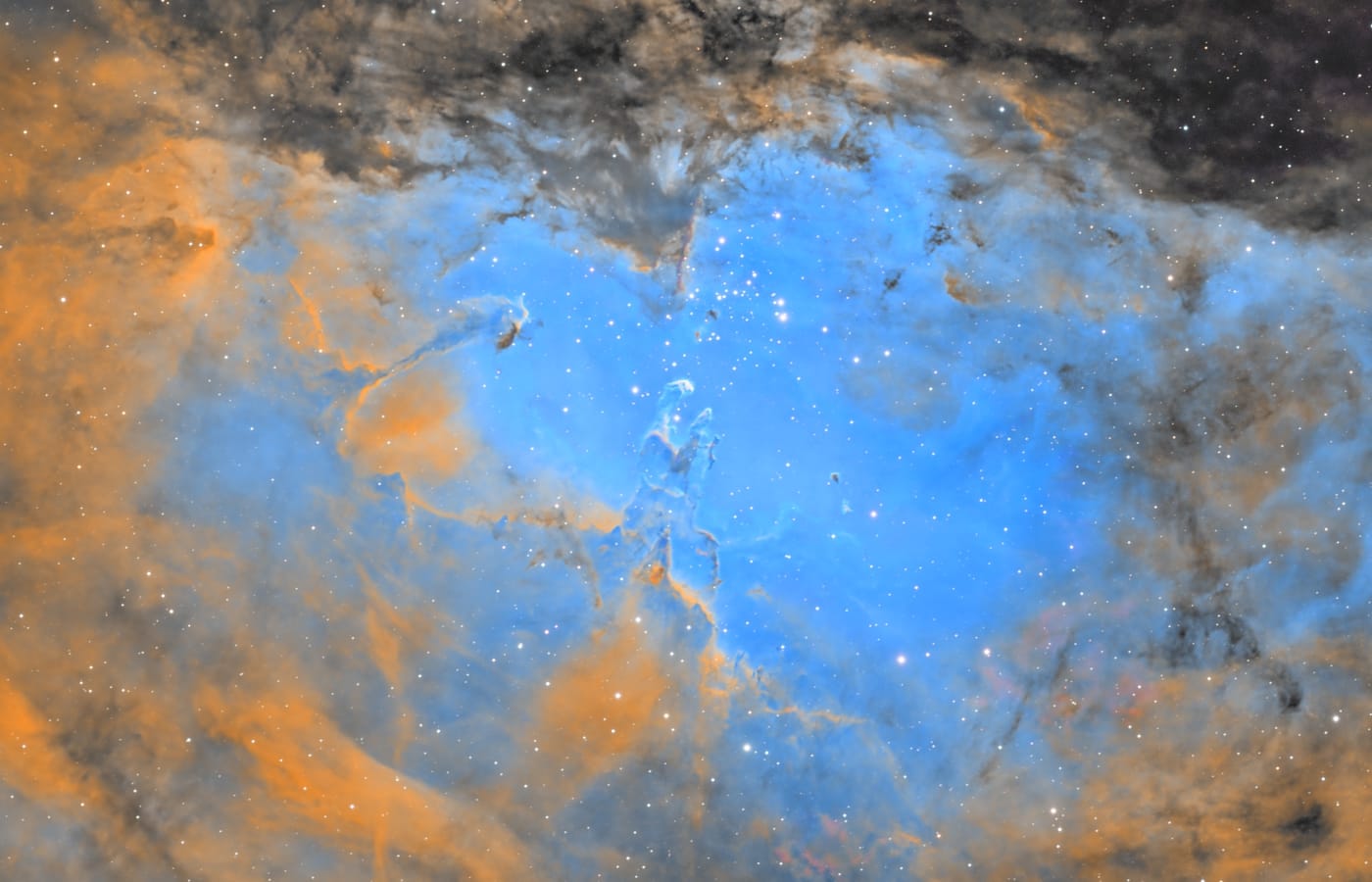
Here they are - the most photographed light-years in the sky, occupying a fingernail's width of this frame. Each pillar is a column of cold gas dense enough to resist the cluster's radiation, several light-years tall, with new stars condensing inside the fingertips. And here's the argument that won't die: in 2007, Spitzer infrared data suggested a supernova shock wave may have already torn the pillars apart - meaning we could be admiring ghosts, their destruction hidden from us for another millennium or two. Later studies pushed back, and astronomers still argue about it. Either way, seeing them this small, engulfed by the machinery that made them, is the point of this framing.
The Southern Dark Trunk
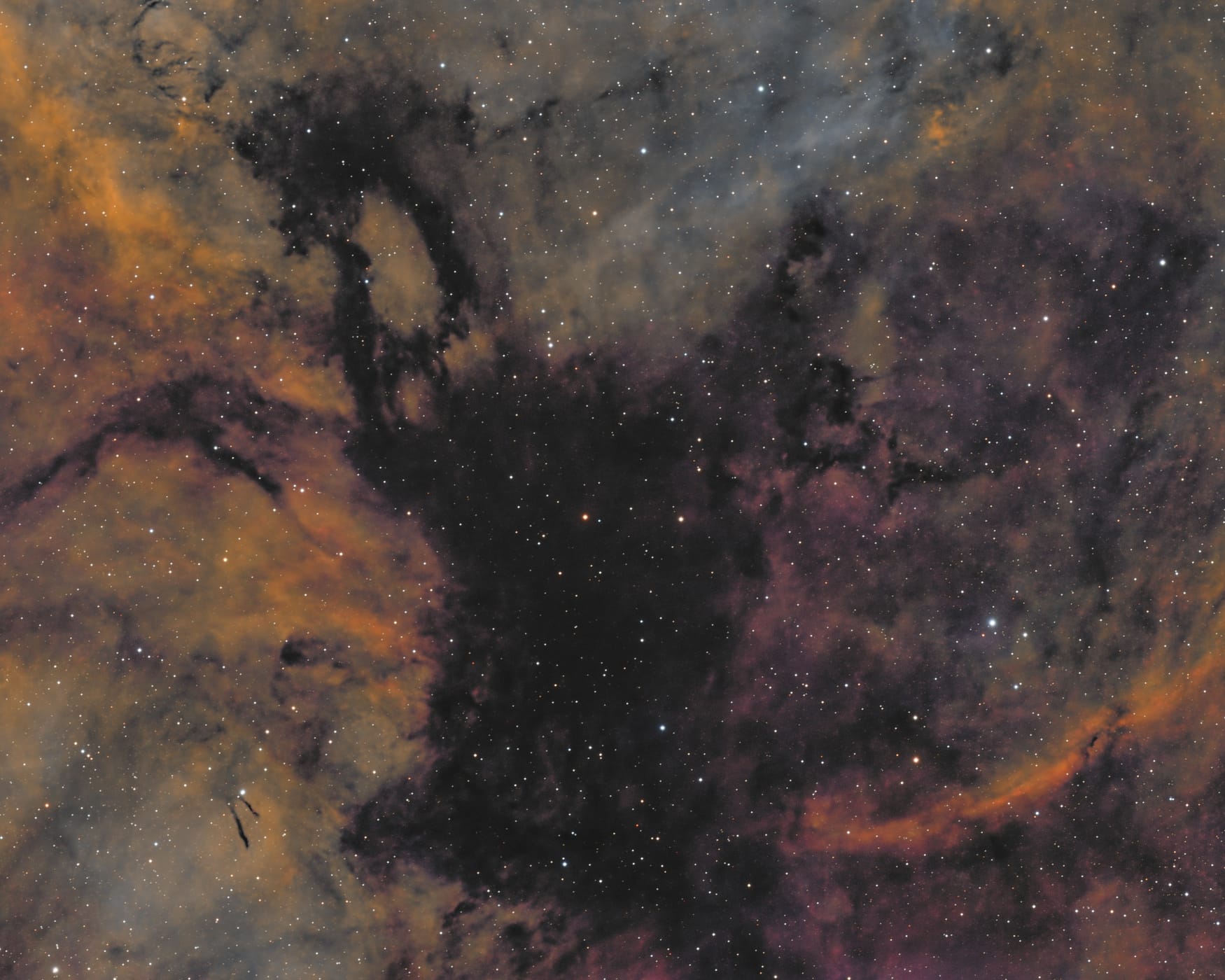
The quiet irony of the Eagle: the biggest pillar in the picture isn't the famous one. This hooked mass of dust intruding from the south dwarfs the Pillars of Creation, and it's being shaped by exactly the same physics - the cluster's radiation ablates the low-density gas around it while the dense core holds its ground, leaving a trunk that points back at its tormentor. Look along its rim for the thin bright edge where ionized gas is boiling directly off the dust.
The Outer Shell
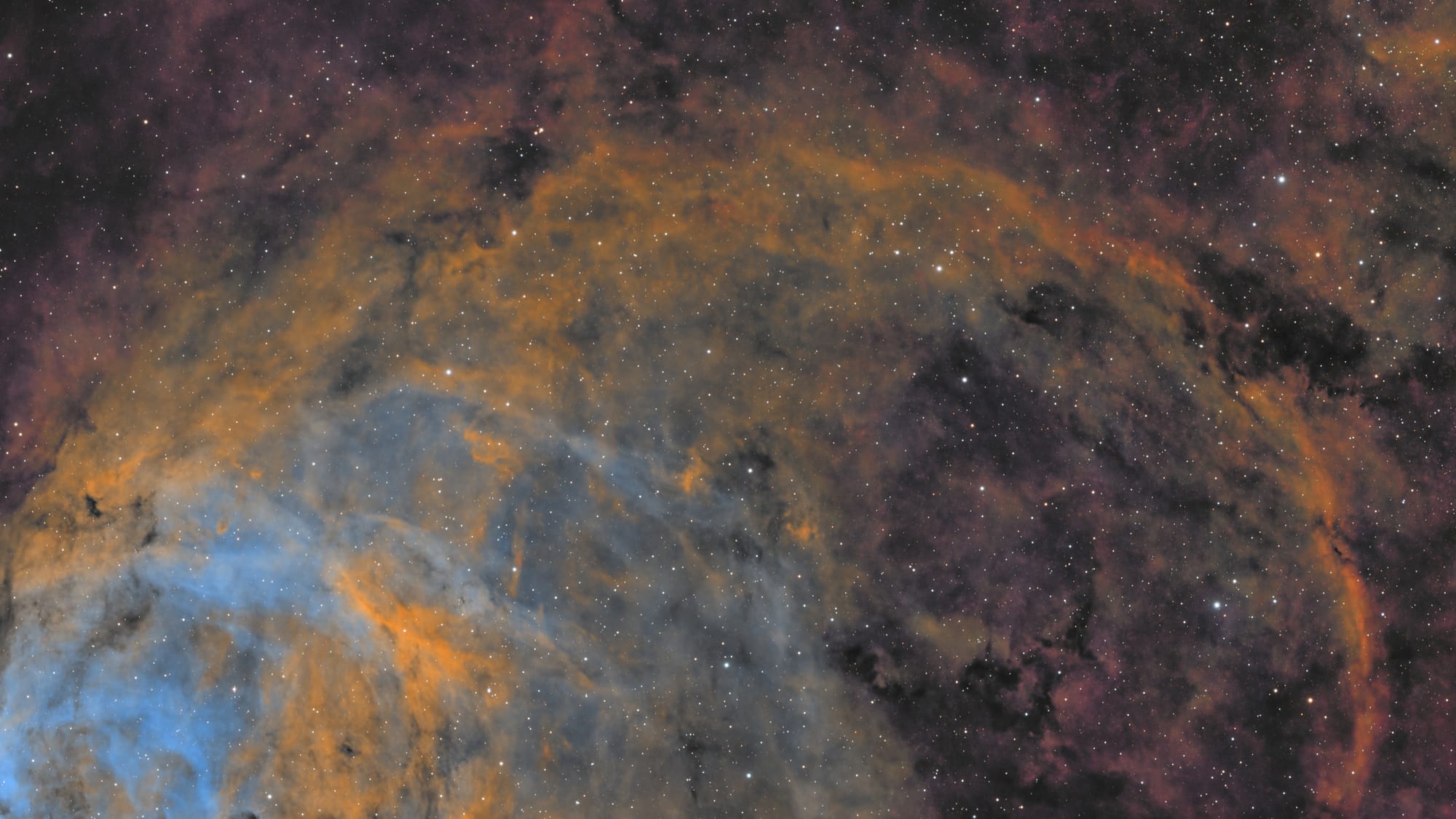
Most images of M16 stop where the blue glow fades. Keep going and you find this: a colossal arc of hydrogen and sulfur curling around the southeast side of the complex, the visible boundary where the nebula's expansion piles into the surrounding interstellar medium. The layered, wind-blown texture - sheets stacked on sheets - records millions of years of pressure from NGC 6611's winds and radiation. This arc is the wingspan that gives the Eagle its name, and it simply doesn't fit in a longer focal length.
Finding It
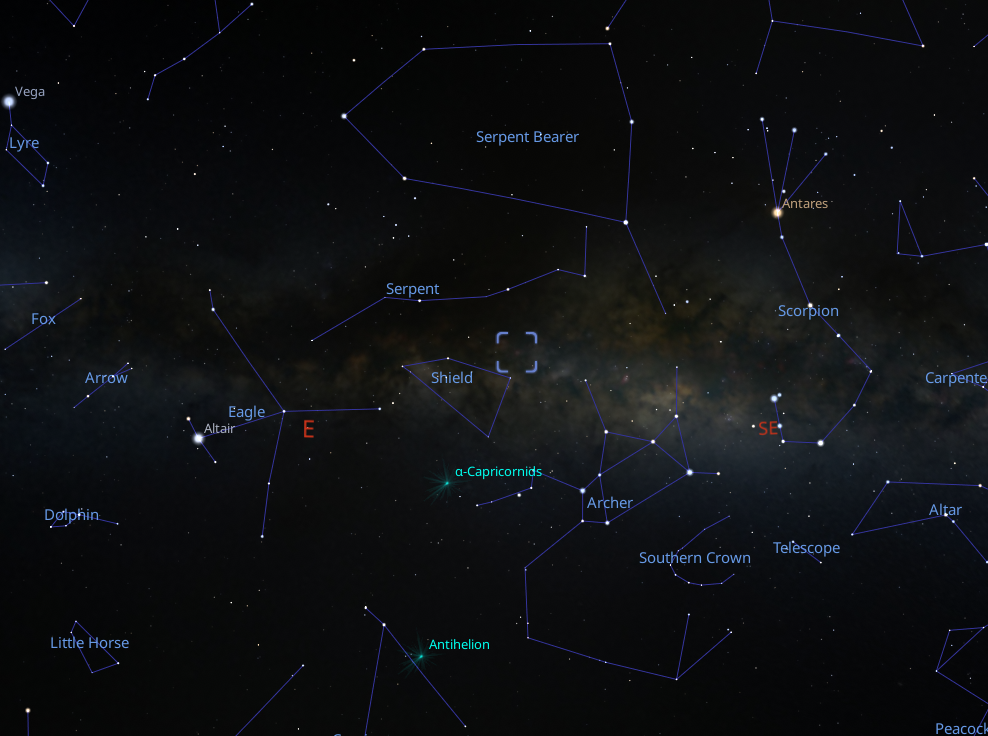
M16 sits at RA 18h 18m 48s, Dec -13° 47′, by the tail of the Serpent. The easy route: find the Teapot of Sagittarius low in the south on a summer evening and ride the steam of the Milky Way upward - you'll pass M17, the Swan, and M16 is barely 2.5° further north; the pair fits in one binocular field. June through August are the prime months.
Acquisition Details
| Filter | Exposure | Subs |
|---|---|---|
| SII | 300s | 56 |
| Ha | 300s | 46 |
| OIII | 300s | 122 |
| Red | 30s | 77 |
| Green | 30s | 76 |
| Blue | 30s | 70 |
| Equipment Type | Equipment |
|---|---|
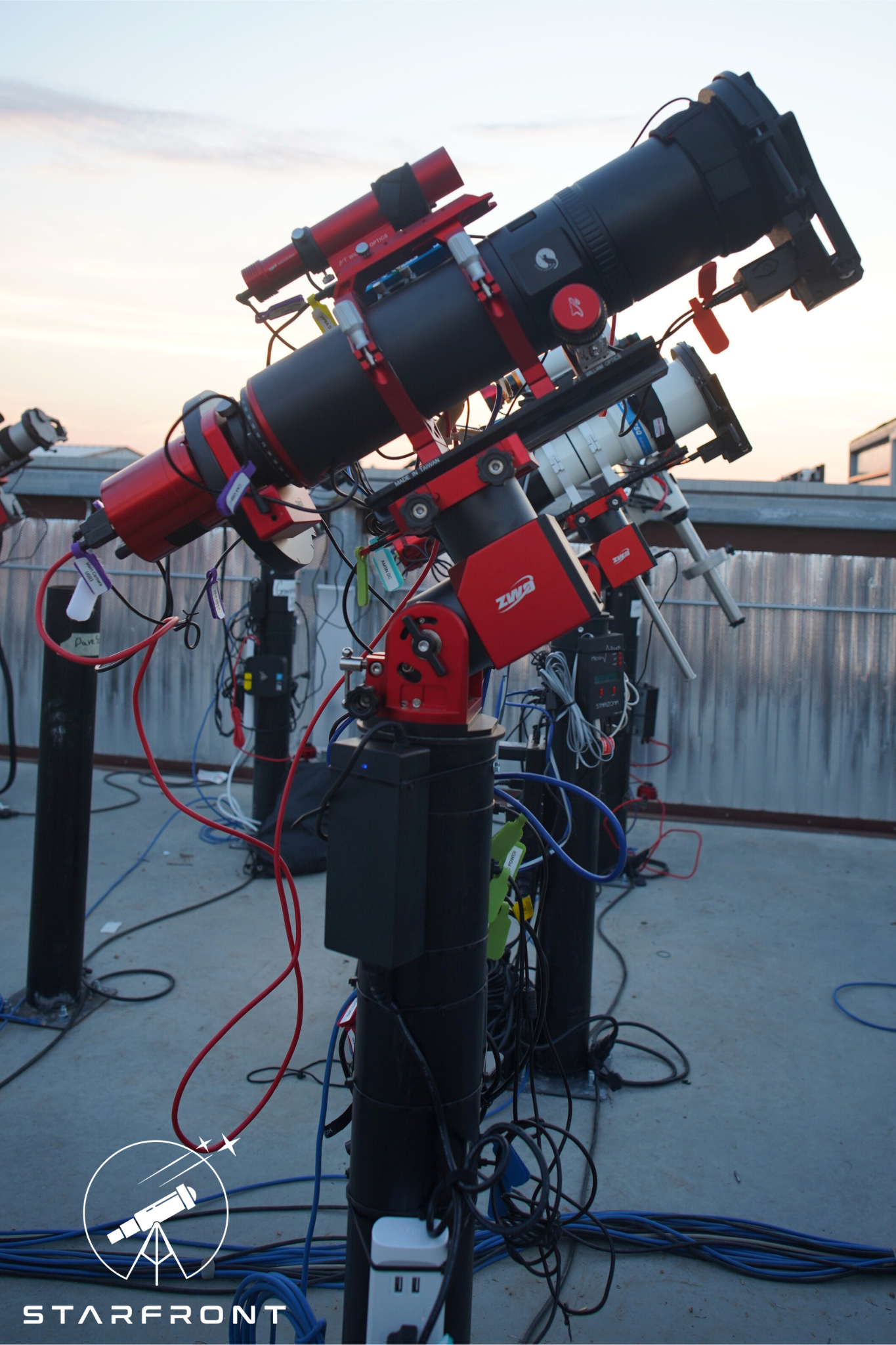
| Telescope | Redcat 91 |
| Imaging Camera | ZWO ASI2600MM Pro |
| Mount | ZWO AM5N |
| Filters | Antlia 3nm (S,H,O) |
| Accessories | ZWO CCA, ZWO EFW (7x2"), ZWO EAF, DeepSkyDad FP2 |
| Capture Software | N.I.N.A. |
| Processing Software | Pixinsight, RC Astro, SetiAstro |
⭐ Stars (RGB)
🌌 Nebula (SHO)