
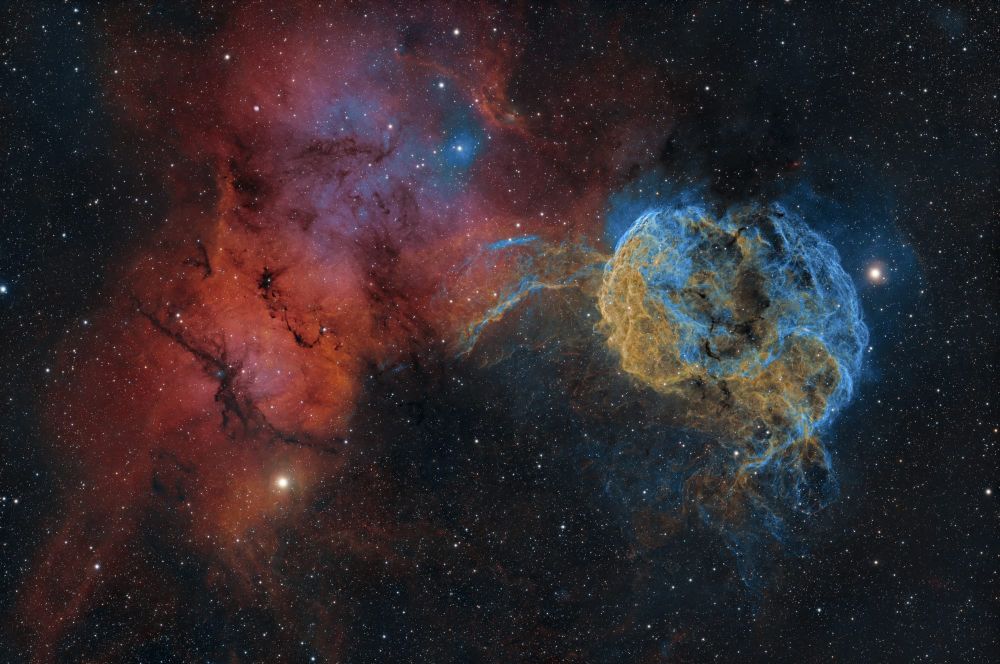
The Jellyfish Nebula and Its Neighborhood: IC 443 in Gemini
There's a supernova remnant in Gemini that looks, unmistakably, like a jellyfish drifting through a red sea. IC 443 is the tangled shell of a star that destroyed itself somewhere between 3,000 and 30,000 years ago, astronomers still argue about the timing, and it's one of the most studied supernova remnants in the sky du to it's unusual behavior: crashing directly into a giant molecular cloud.
This frame covers about 3° × 2° of sky, which is what makes this composition work. The Jellyfish is usually shot tight and alone. Pull back, and it turns out to be one actor in a much busier scene.
The Field
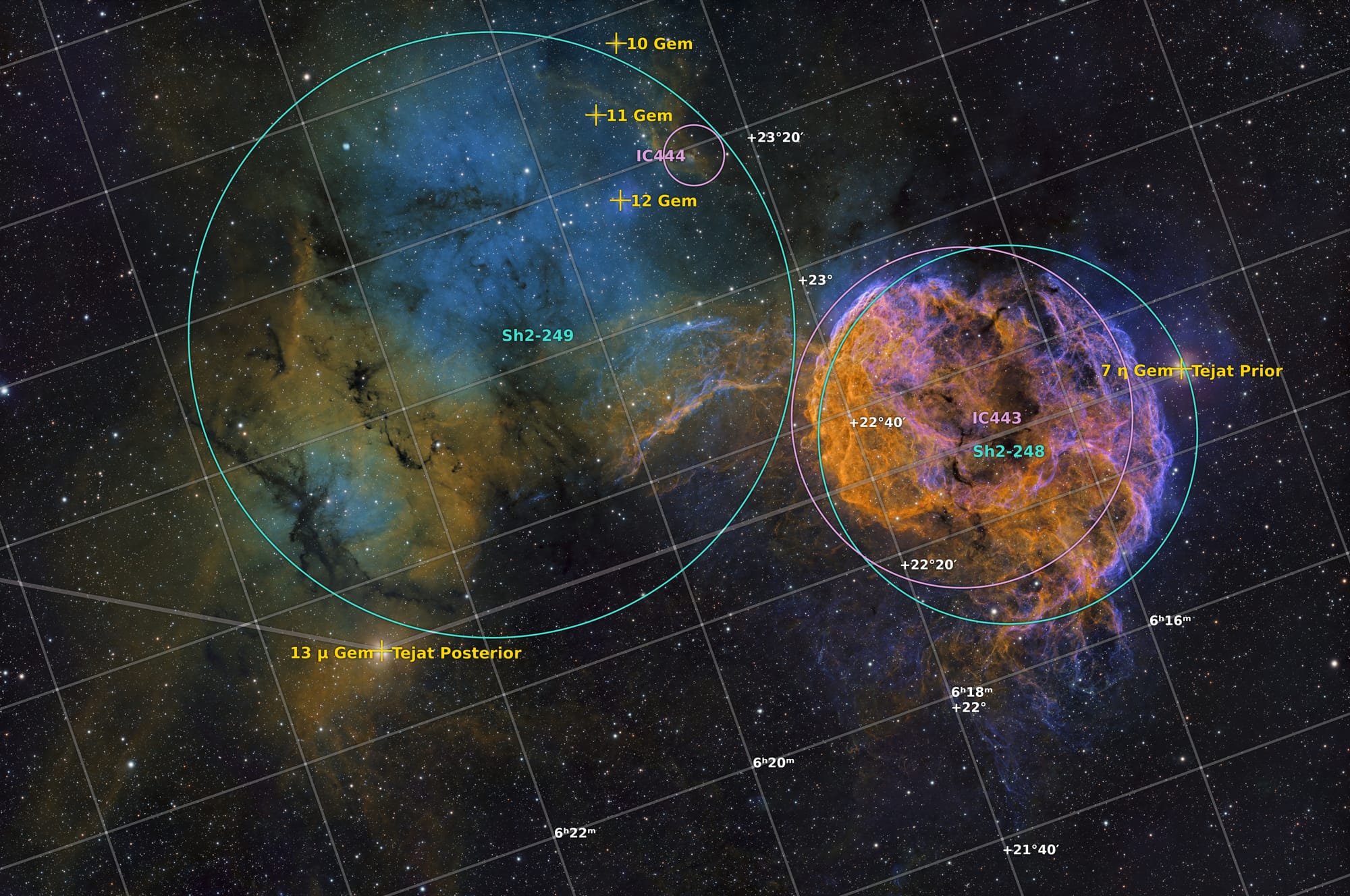
On the right, the Jellyfish itself: a roughly circular shell of shocked gas about 70 light-years across, glowing in a purple oxygen and gold sulfur/hydrogen in this SHO palette. On the left, the sprawling emission region Sh2-249 (with the reflection-tinged IC 444 embedded in it), laced with dark dust lanes that snake across the glowing hydrogen like cracks in stained glass. Between them, faint golden tendrils physically connect the two regions - the Jellyfish isn't floating in isolation; it's embedded in the same star-forming complex it's now demolishing.
The brilliant orange star near the remnant is Propus (η Geminorum), a naked-eye variable star roughly 380 light-years away - a foreground bystander, nowhere near the nebula, but a useful anchor: if you can find Propus between Betelgeuse and the Gemini twins, you're looking straight at the Jellyfish.
The Eastern Shock Front
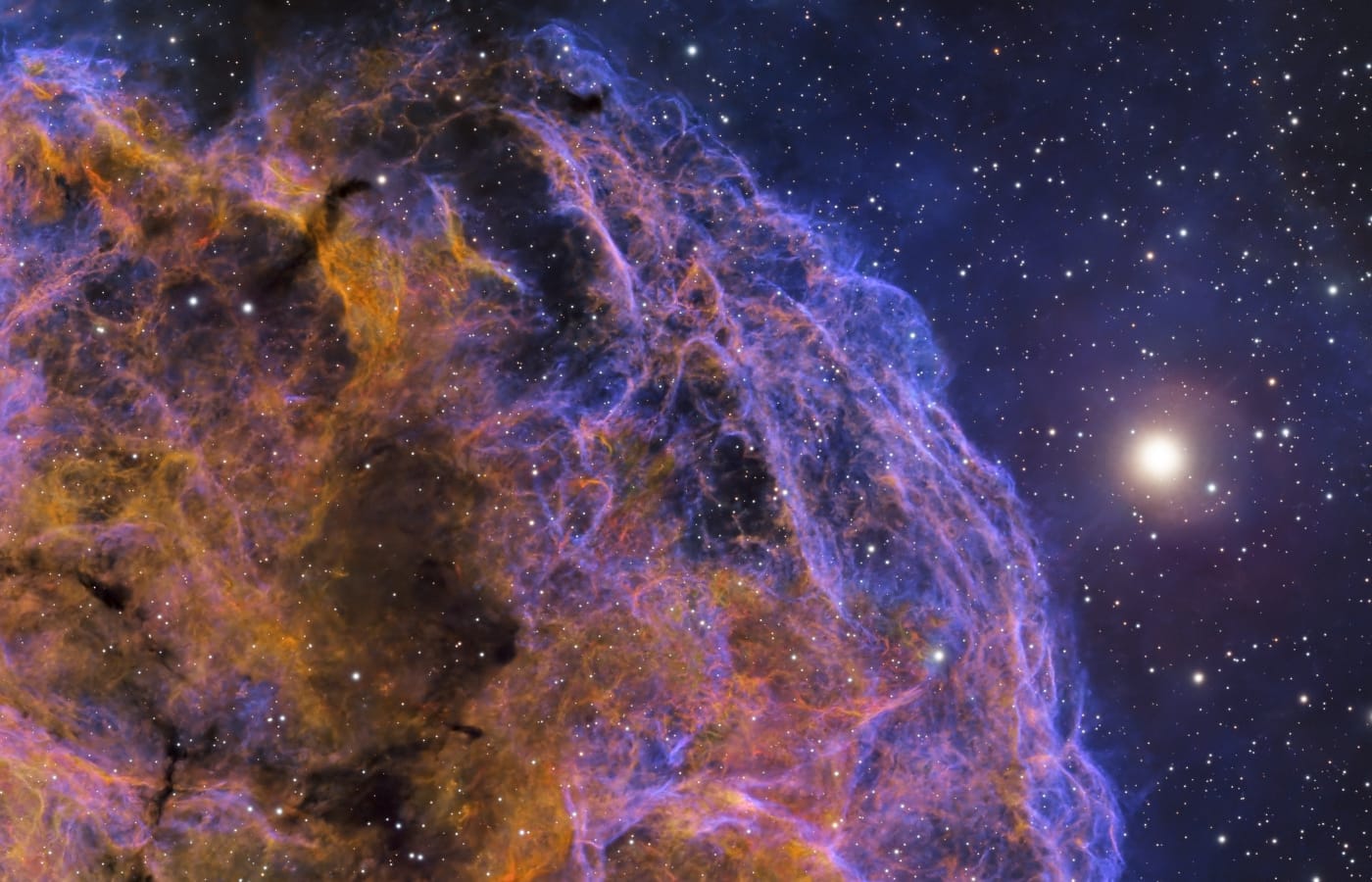
This is the business end of the remnant. The eastern edge is where the expanding shock wave slams into a dense molecular cloud, and you can see the physics in the structure: the filaments here are brighter, sharper, and more compressed than anywhere else in the shell. The braided, rope-like texture is the shock wave being decelerated and wrinkled as it eats into denser material. On the opposite (western) side, where the gas is thinner, the shell fades into soft purple wisps - the blast wave running downhill with nothing to push against.
The Tentacles
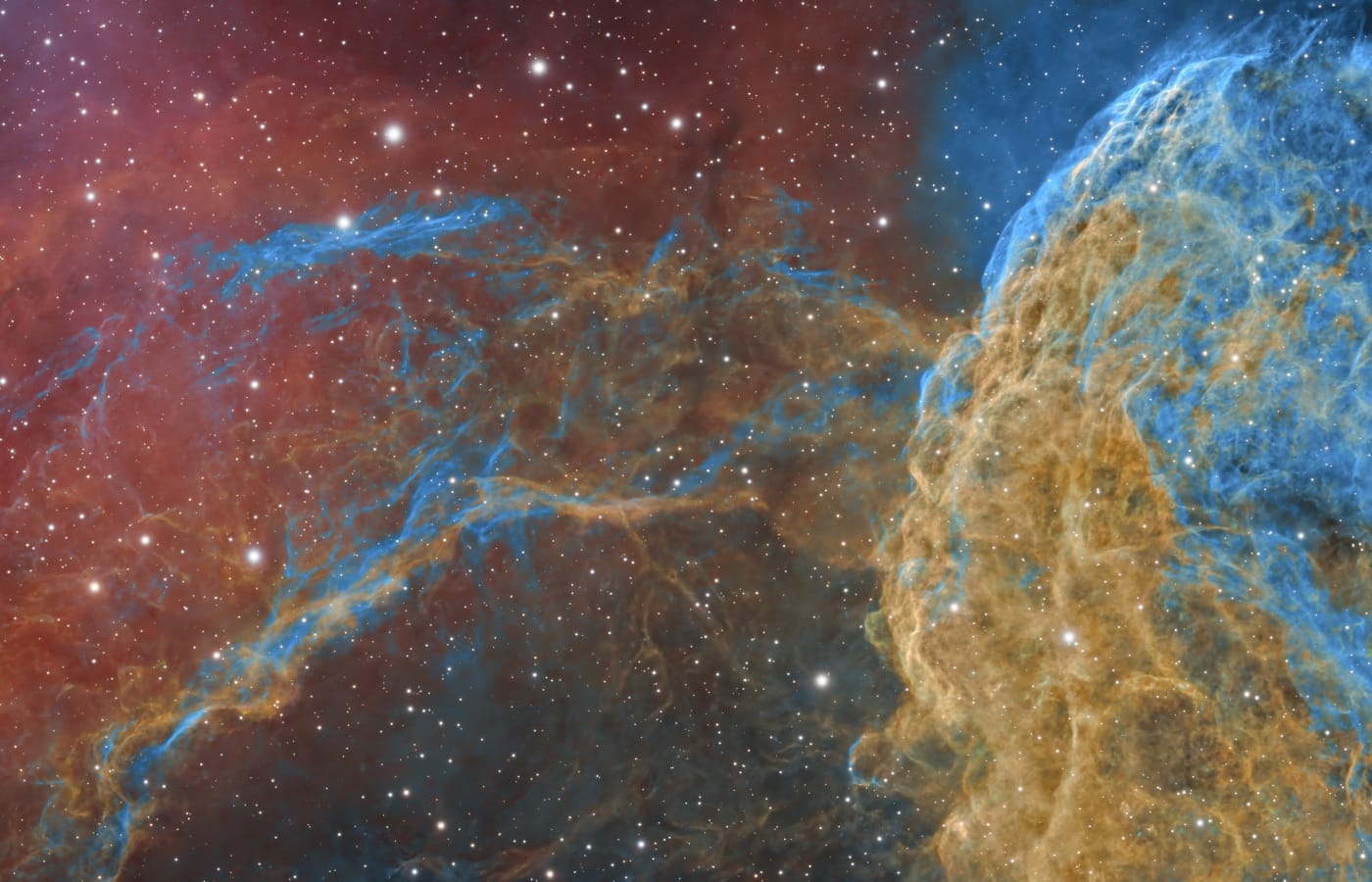
The streamers that give the Jellyfish its name trail off toward the northwest, reaching for the Sh2-249 complex. In narrowband, these show up as intertwined gold (Hα/SII) and blue (OIII) filaments - different gases cooling at different rates behind the shock. Deep in the remnant's interior sits a neutron star, CXOU J061705.3+222127, the crushed core of the original star, discovered plowing its own small wake through the debris. It's far too faint for amateur equipment, but it's satisfying to know the culprit is still at the scene.
Dust Against Fire
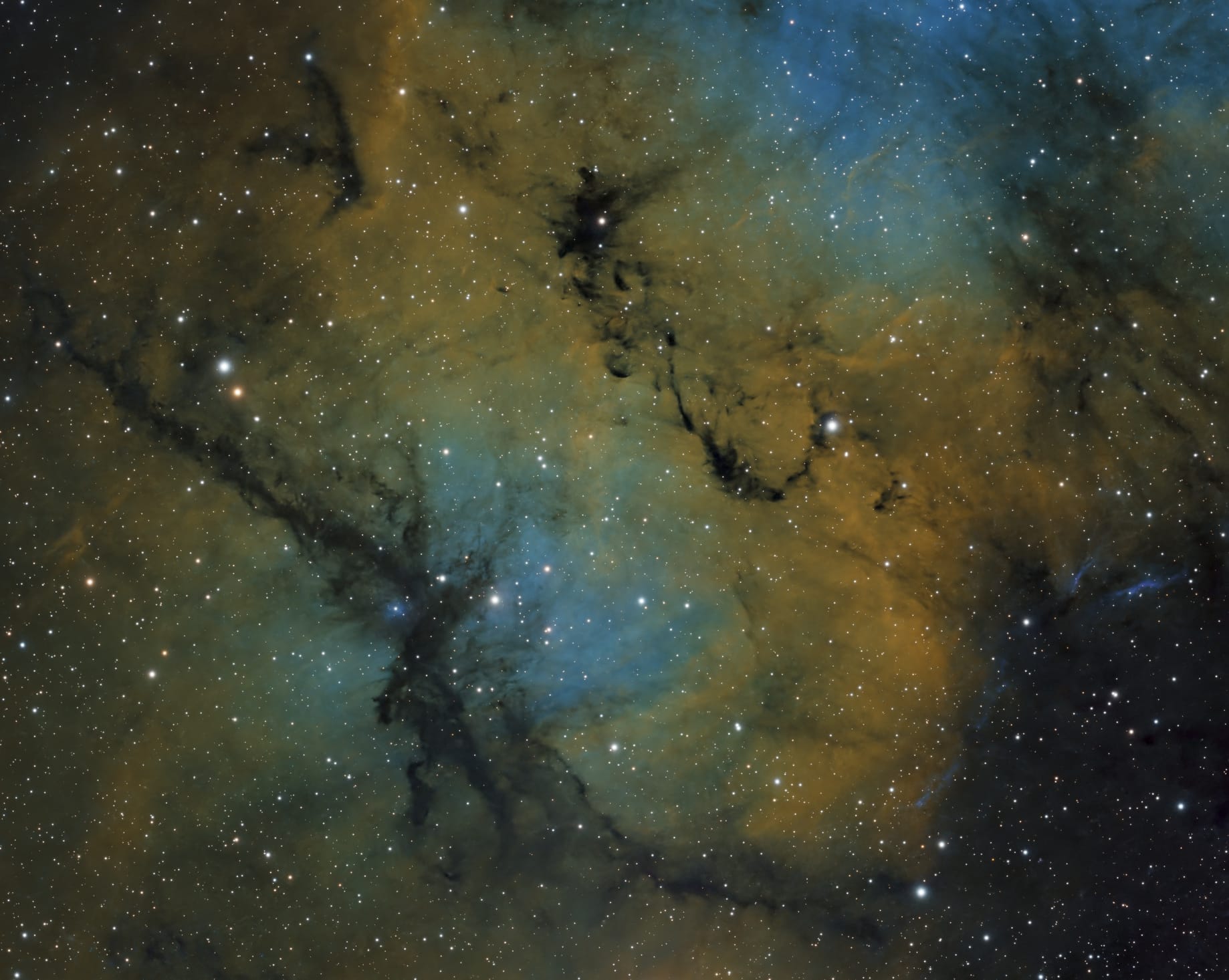
The left half of the frame is a completely different subject that happens to share the field: Sh2-249, a large HII region where hydrogen is being lit up by hot young stars, crossed by opaque dust lanes (cataloged as LDN 1564/1565/1566). These dark nebulae aren't empty - they're the densest, coldest material in the frame, the raw fuel for the next generation of stars. The contrast is the story: on one side of the image a star being born from dust; on the other, the wreckage of one that already died.
Finding It
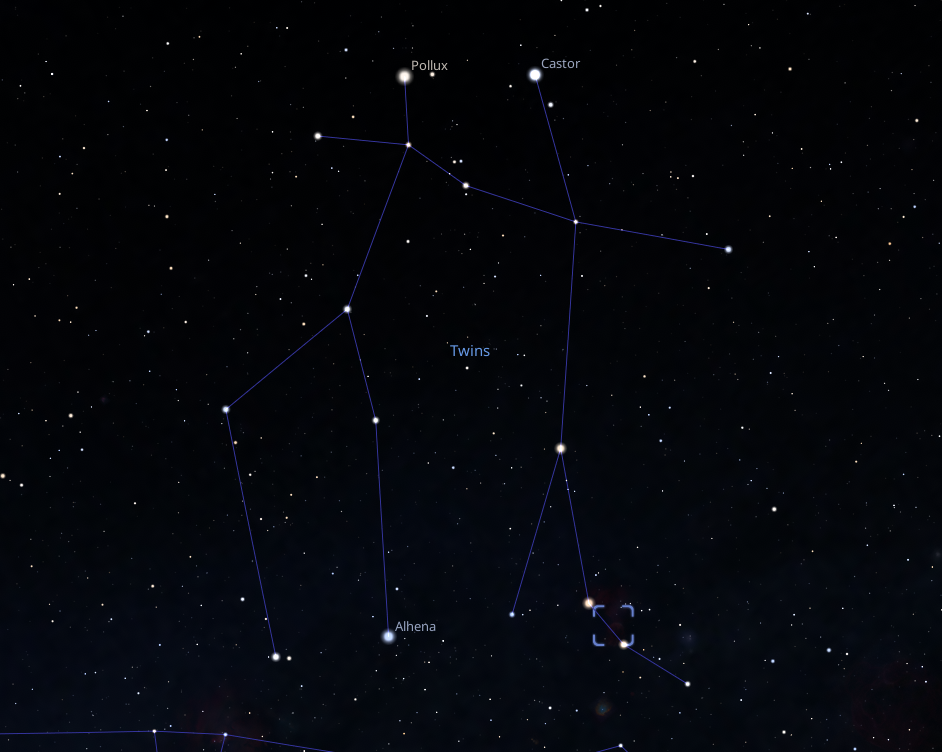
IC 443 lies in Gemini at roughly RA 06h 17m, Dec +22° 31′, almost exactly on the line between Betelgeuse and Pollux, right beside the third-magnitude star Propus (η Gem). It transits high from mid-northern latitudes in winter, making it most visible December-through-February.
Acquisition Details
| Filter | Exposure | Subs |
|---|---|---|
| SII | 300s | 174 |
| Ha | 300s | 173 |
| OIII | 300s | 171 |
| Equipment Type | Equipment |
|---|---|
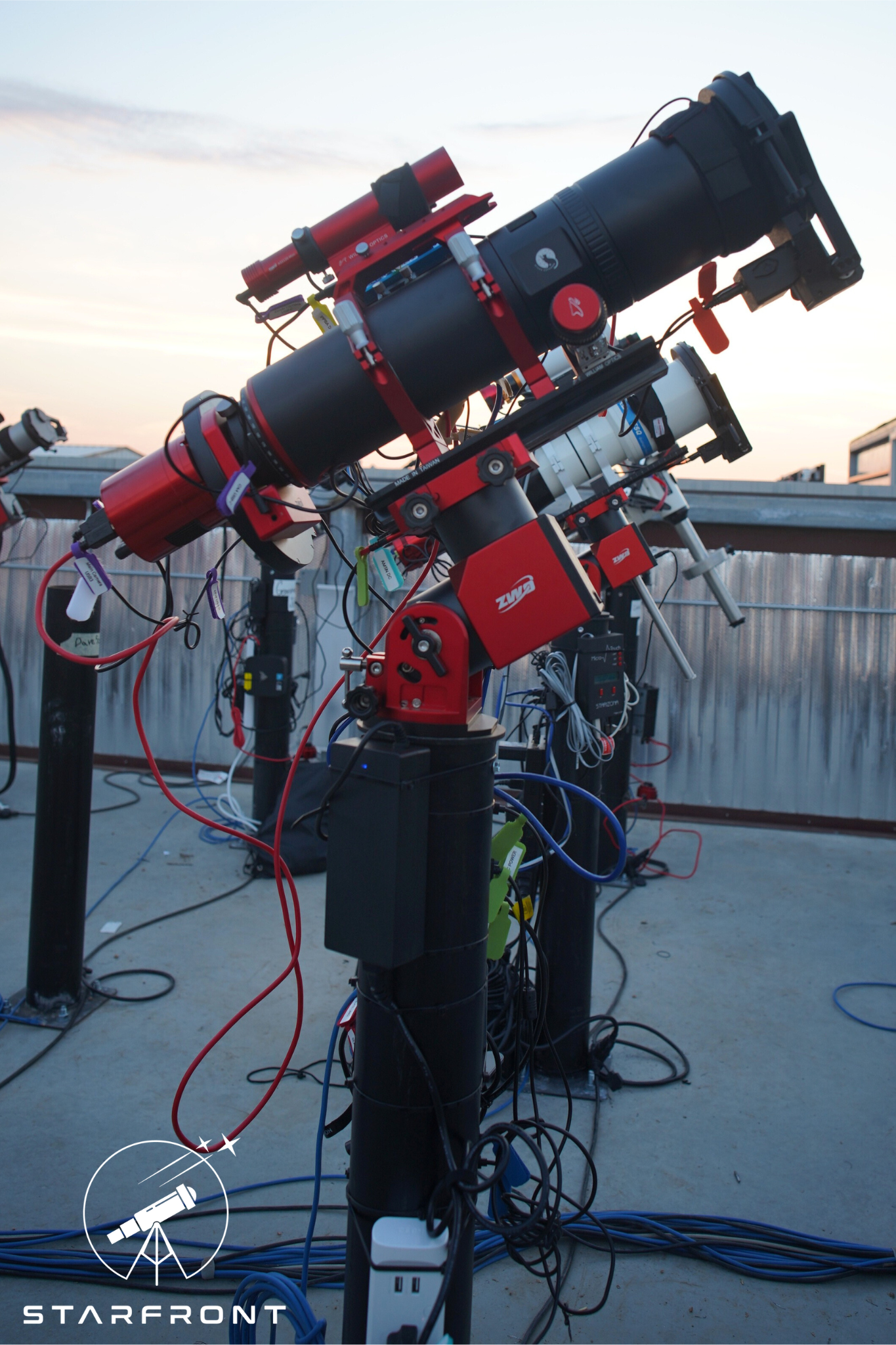
| Telescope | Redcat 91 |
| Imaging Camera | ZWO ASI2600MM Pro |
| Mount | ZWO AM5N |
| Filters | Antlia 3nm (S,H,O) |
| Accessories | ZWO CCA, ZWO EFW (7x2"), ZWO EAF, DeepSkyDad FP2 |
| Capture Software | N.I.N.A. |
| Processing Software | Pixinsight, RC Astro, SetiAstro |
All processing completed in PixInsight
⭐ Stars
🌌 Starless nebula
