
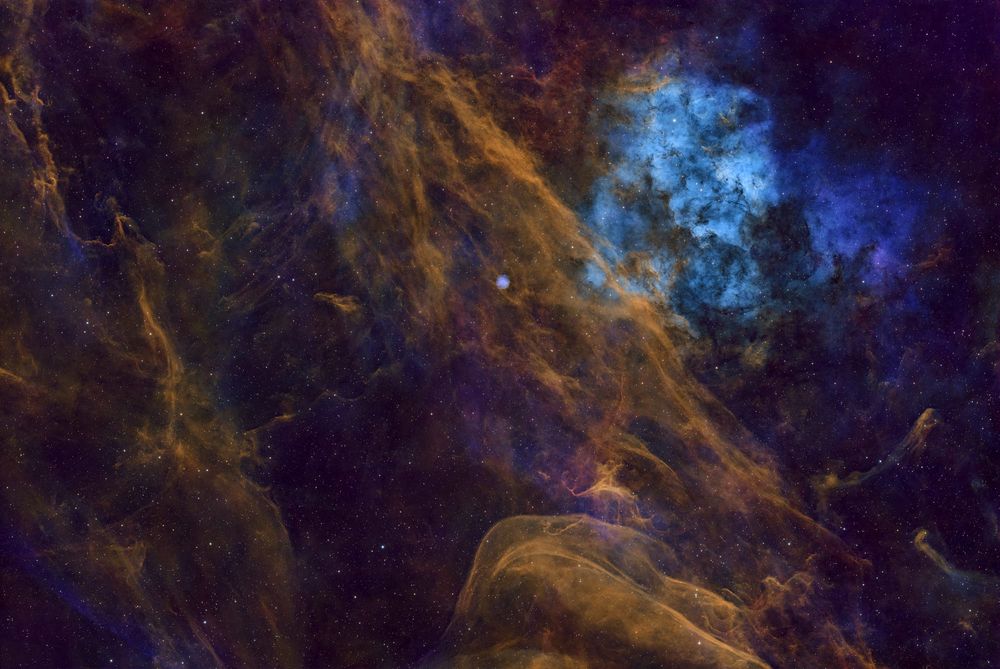
Dark nebulae are the only objects in astrophotography you image by what they hide. LDN 939 is a cold cloud of molecular dust drifting through one of the busiest neighborhoods in the northern sky, and the only reason we can see it at all is that Cygnus burns behind it - thirty-five hours of narrowband exposure reveal the darkness not as empty sky, but as ink spilled across a glowing canvas.
The RedCat 91's roughly 3° × 2° field is what makes this target work. LDN 939 doesn't sit alone: its dust threads across the blue oxygen glow of Sh2-115, a tiny contested planetary nebula floats near the center of the frame, and ribbons of sulfur-gold hydrogen drape diagonally across the entire scene. A tighter field would show you a dark patch; this one shows you why it's dark.
The Field
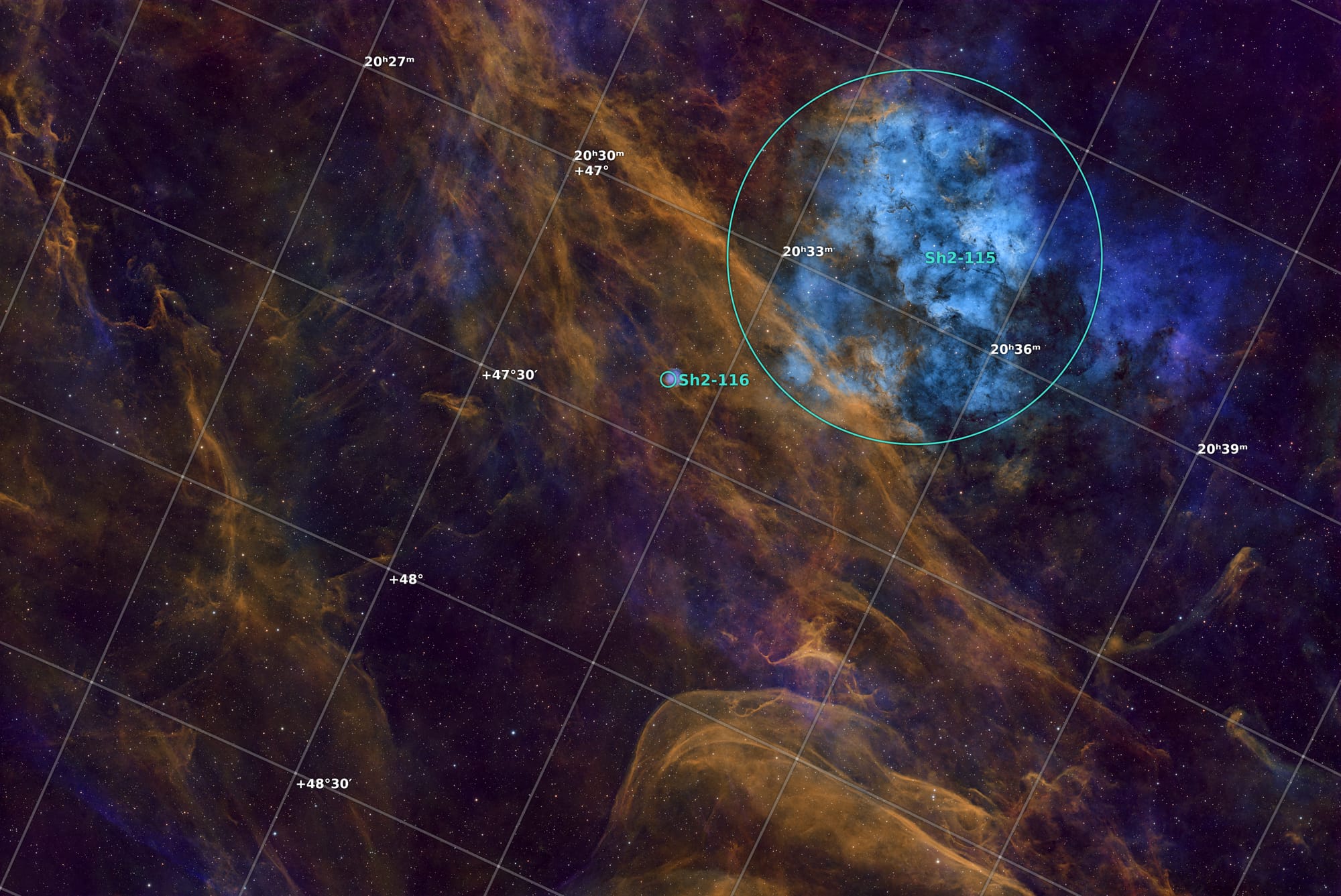
Start at the upper right, where Sh2-115 glows an electric oxygen-blue, some 7,500 light-years away. The black tendrils crazing its surface like cracks in stained glass are the dust of LDN 939 ( this article's namesake ) silhouetted where the cold foreground cloud crosses the hot gas behind it. From there the eye follows the great diagonal: braided ribbons of sulfur and hydrogen rich gas, rendered gold in the SHO palette, running from upper left to lower right like a river across the frame.
Near the very center sits the smallest object in the field and arguably its strangest: a pale blue disc barely a few arcminutes across, cataloged as Abell 71. And along the bottom edge, the gas changes character entirely: instead of braided filaments, it drapes in smooth, translucent arcs, like a sheet caught mid-billow. This whole region lies just a couple of degrees from Deneb, the tail star of the Swan, in one of the most emission-choked sightlines in the entire Milky Way.
Sh2-115 and the Ink of LDN 939
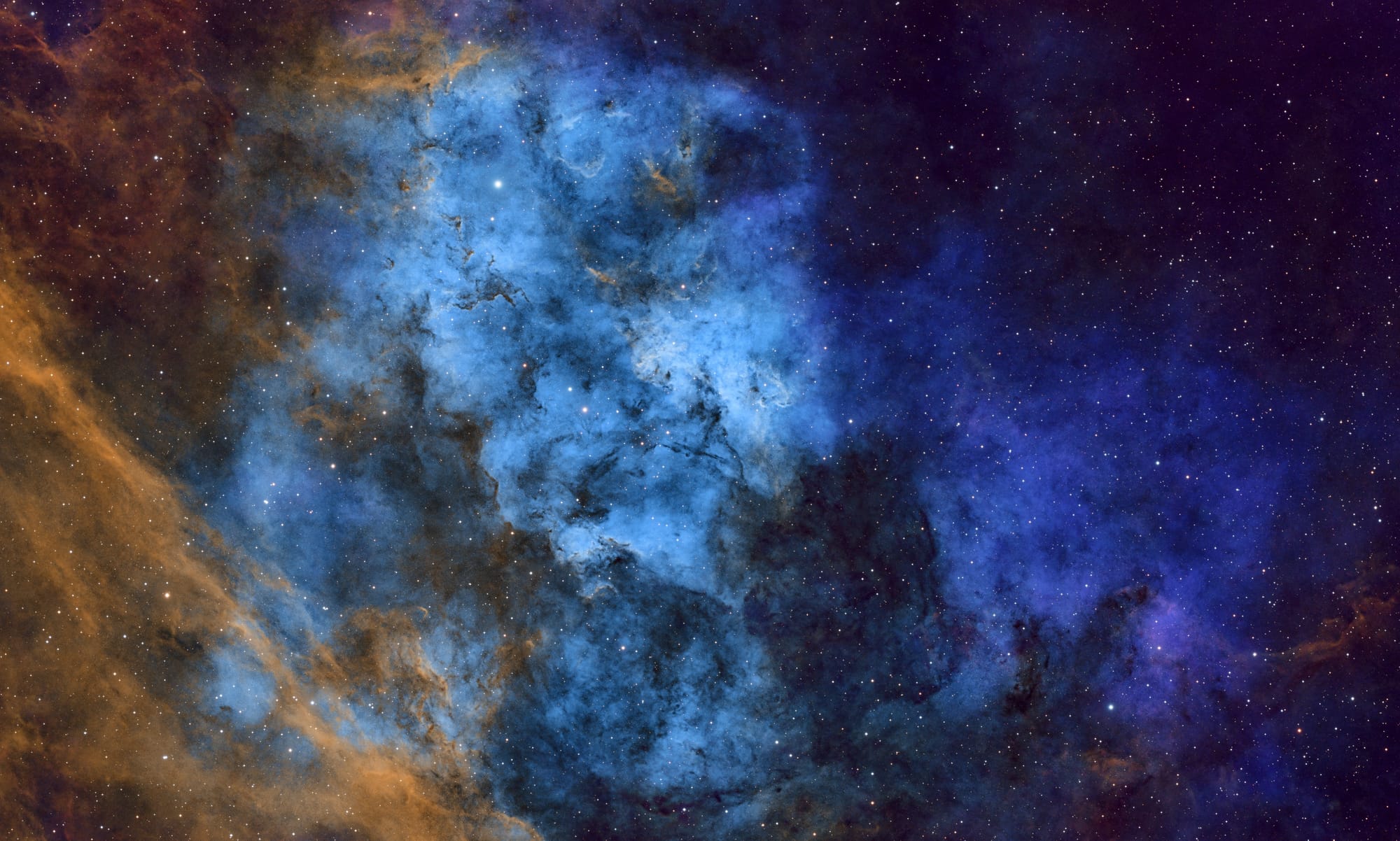
This crop is the heart of the image, and it's a study in contrast between two clouds that have nothing to do with each other. Sh2-115 is hot: an HII region whose strong OIII response gives it that blue, mottled glow, lit from within by a small cluster of young stars (cataloged as Berkeley 90, though you won't find it labeled - its stars simply blend into the crowd). LDN 939 is cold: dense molecular dust opaque enough to blot out everything behind it. Where the two overlap along our line of sight, the dark cloud is printed onto the bright one in perfect silhouette - every twist and knot of the dust rendered in negative. Look for the places where the dark lanes feather at their edges; that's the transition zone where the dust thins enough for the glow to start bleeding through.
Abell 71, the Impostor(?)
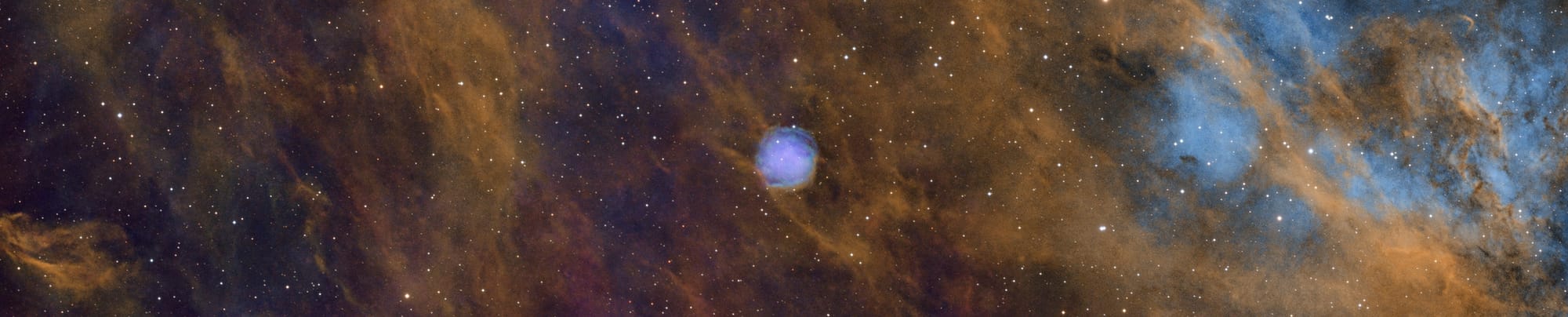
Here's this image's quirky truth: nobody is entirely certain what Abell 71 is. It carries two catalog identities: Abell 71 as a planetary nebula, Sh2-116 as an HII region, the literature has argued both sides for decades. A true planetary nebula would be the exhaled outer layers of a dying sun-like star; the skeptics' case is that it's merely a chance knot of ambient ionized gas, an impostor wearing a planetary's round shape in a region absolutely saturated with glowing hydrogen. Either way, at roughly three arcminutes across it's a delicate catch, and its soft blue disc floating against the gold filaments is one of my favorite details in the frame.
The Golden River
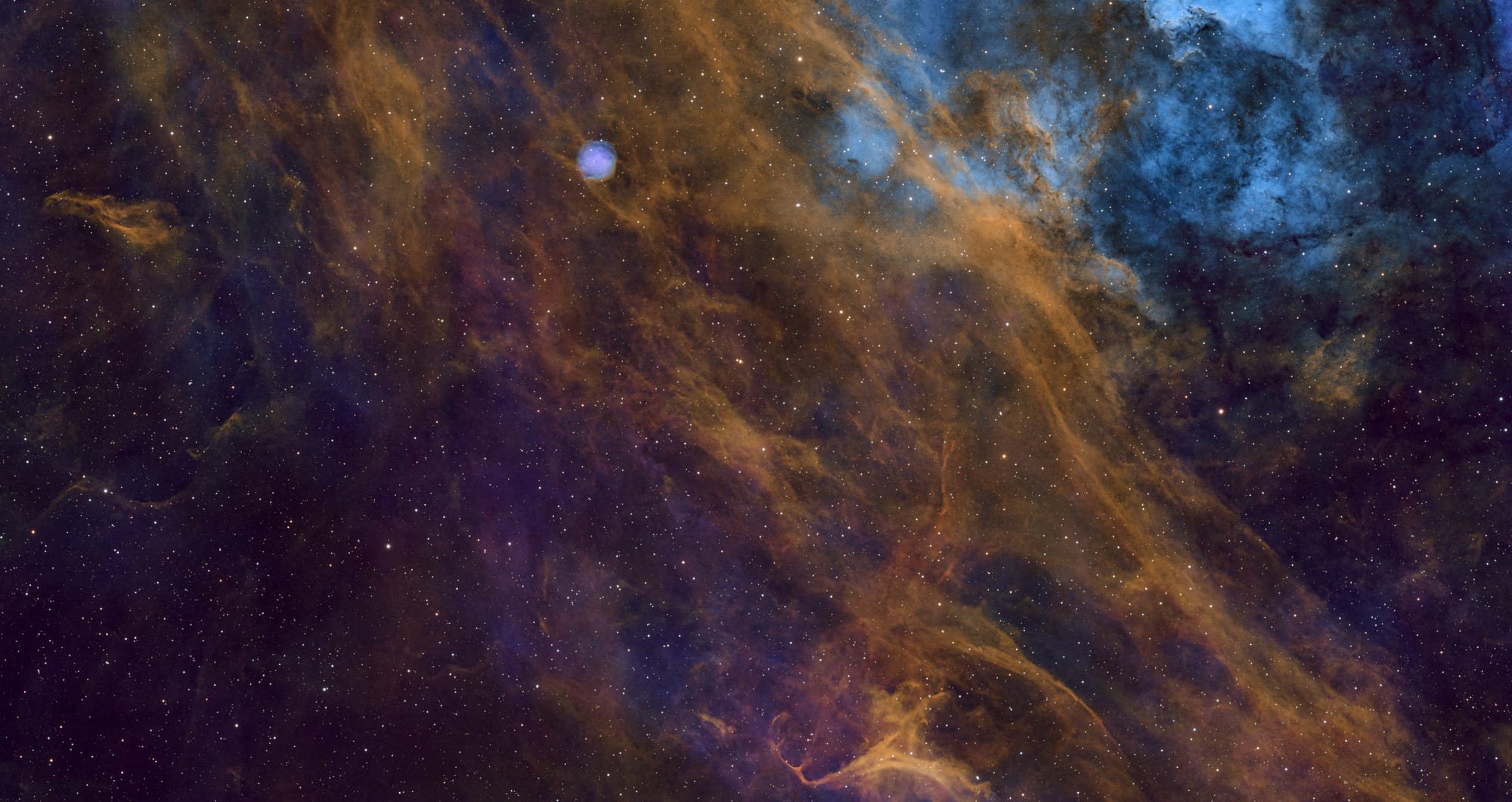
The diagonal ribbons dominating the frame are part of the vast Cygnus emission complex, and their color is doing real scientific work. In the SHO palette, gold means sulfur and hydrogen are glowing together; lower-energy emission, gas that's ionized but not fiercely so. The braided, rope-like texture traces where shock fronts and stellar winds from generations of massive Cygnus stars have compressed the gas into sheets seen edge-on. Follow any single strand and watch it split, twist, and rejoin: this is turbulence written out at a scale of light-years.
The Wave
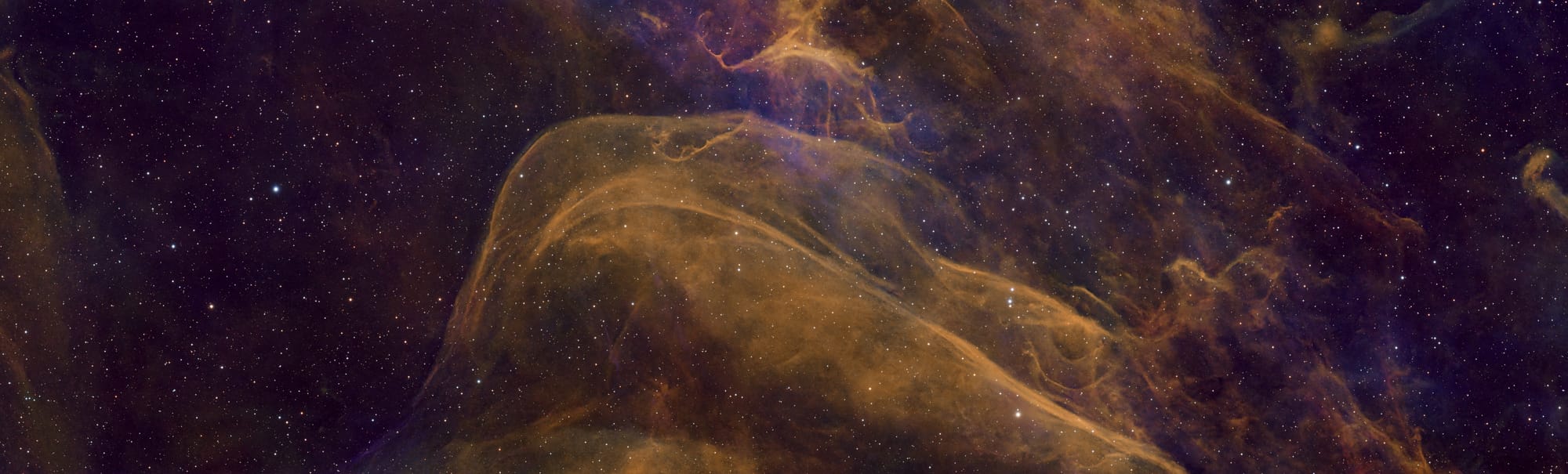
The bottom of the frame belongs to a completely different texture. Where the central filaments are braided and knotted, these arcs are smooth and translucent, stacked in overlapping curves like silk caught in a breeze. Structures this graceful usually mean the gas here is being shaped gently, pushed by radiation pressure rather than shredded by shocks. It's a quiet counterpoint to the chaos above it, and it's the part of the image that only deep integration reveals; at thirty-five hours, these veils finally separate cleanly from the background.
Finding It
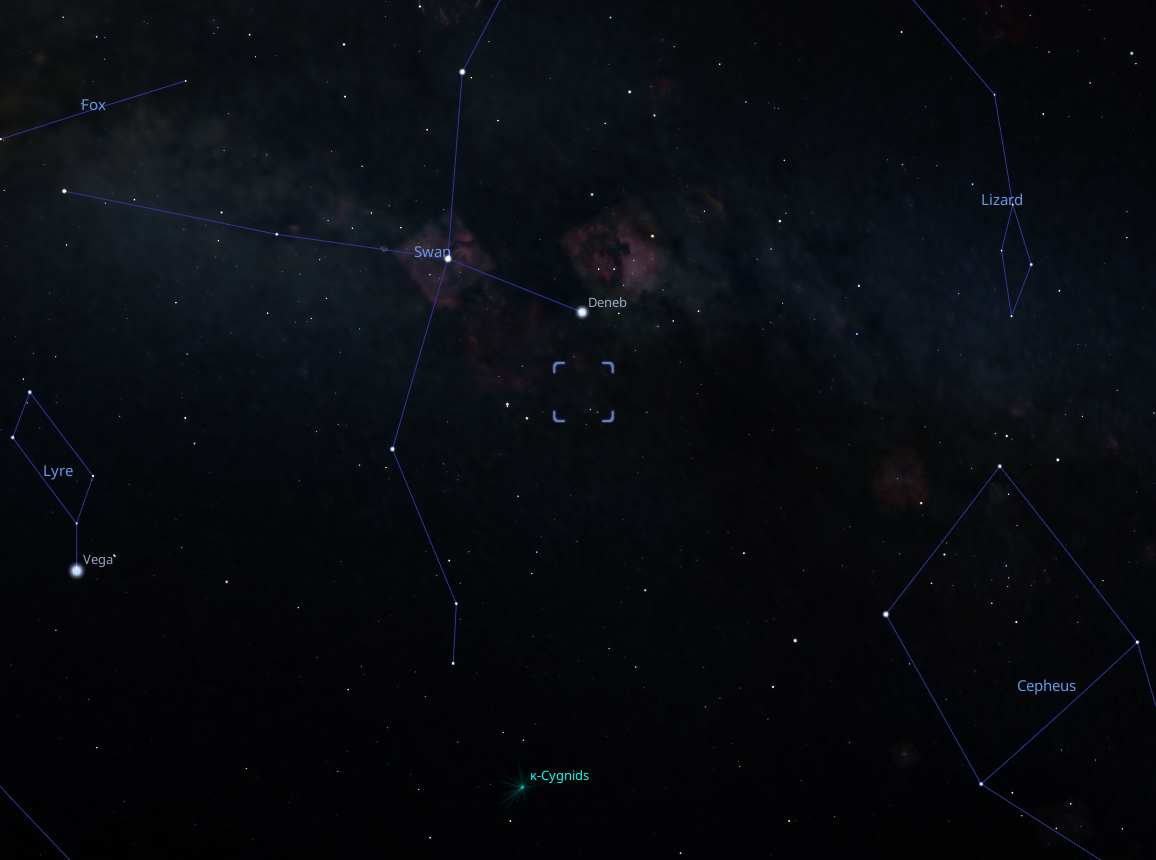
The field sits in Cygnus at roughly RA 20h 33m, Dec +47° 40′, a couple of degrees north-northwest of Deneb, the brilliant tail star of the Swan and the faintest corner of the Summer Triangle. If you can find Deneb (and from any dark site, you can't miss it), you're already there; the entire field fits within a couple of finger-widths of it.
Acquisition Details
| Filter | Exposure | Subs |
|---|---|---|
| SII | 300s | 132 |
| Ha | 300s | 120 |
| OIII | 300s | 168 |
| Red | 30x | 30 |
| Green | 30x | 30 |
| Blue | 30x | 30 |
| Equipment Type | Equipment |
|---|---|
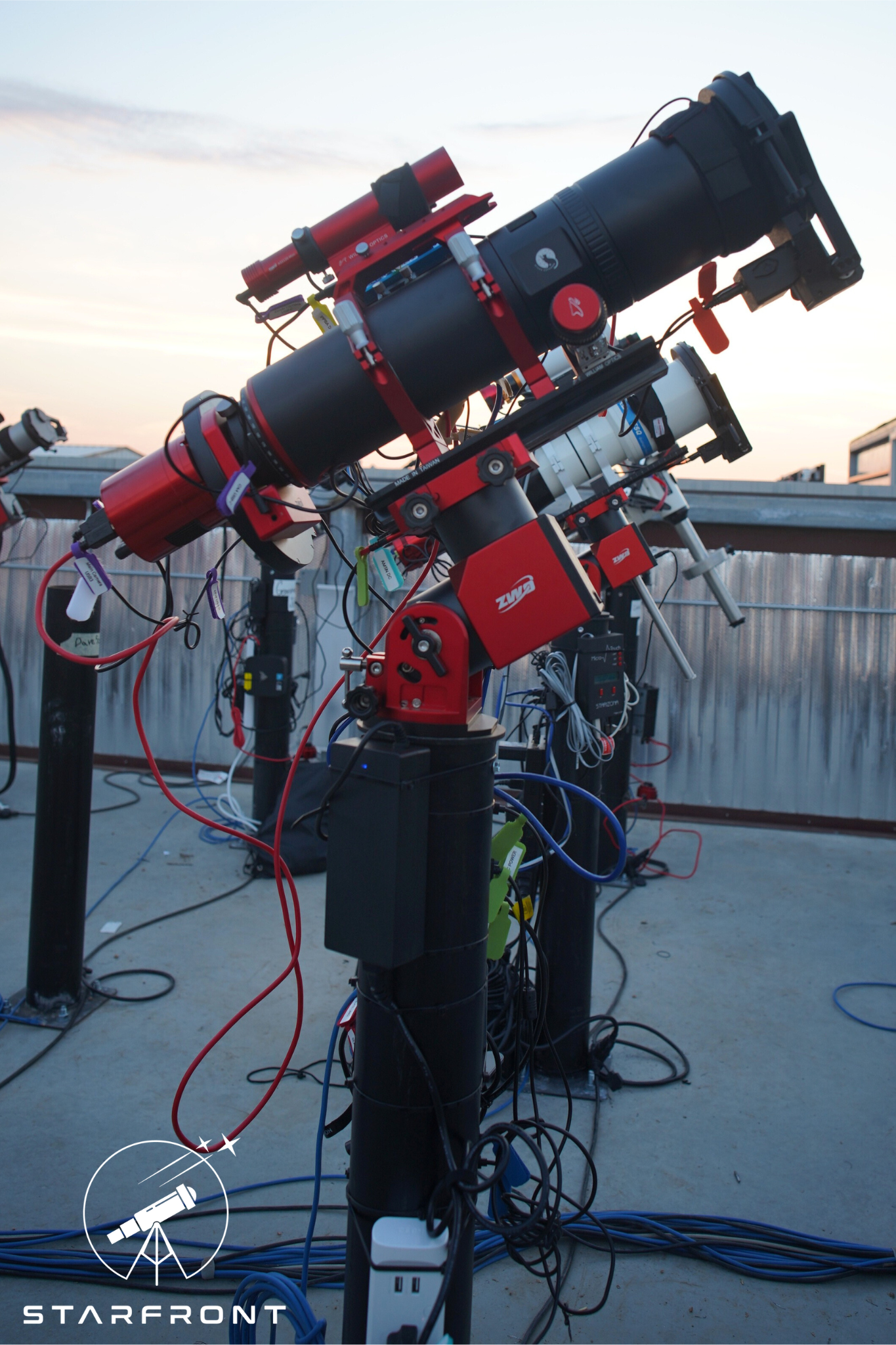
| Telescope | Redcat 91 |
| Imaging Camera | ZWO ASI2600MM Pro |
| Mount | ZWO AM5N |
| Filters | Antlia 3nm (S,H,O), Antlia V-Pro (R,G,B) |
| Accessories | ZWO CCA, ZWO EFW (7x2"), ZWO EAF, DeepSkyDad FP2 |
| Capture Software | N.I.N.A. |
| Processing Software | Pixinsight, RC Astro, SetiAstro |
⭐ Stars (RGB)
🌌 Nebula (SHO)