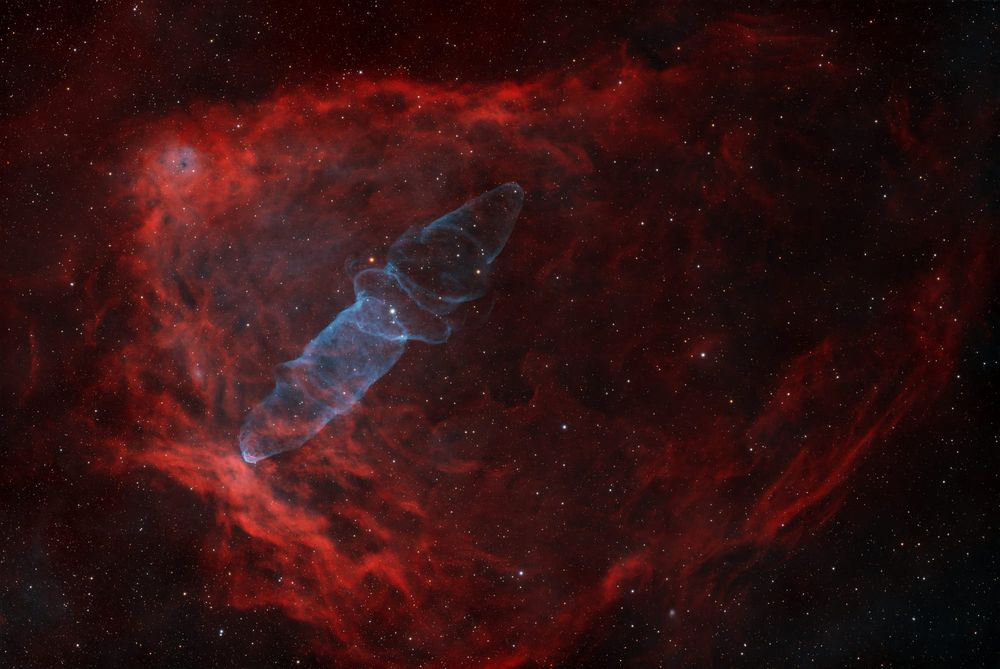
Floating inside the red wings of the Flying Bat Nebula is one of the strangest objects an amateur telescope can reach: OU4, the Squid Nebula - a ghostly, teal-blue bipolar outflow nearly 50 light-years long that nobody knew existed until 2011. It's so faint that a century of professional sky surveys sailed right past it, and astronomers are still working out exactly what's powering it.
This is a target the RedCat 91's ~3.0° × 2.0° field was made for. The Squid alone spans over a degree, and it sits embedded in Sh2-129, a hydrogen shell more than twice that size - so the wide field captures the whole scene at once: the bat, the squid inside it, and the dark, star-poor lanes of Cepheus dust framing them both. This image is 56 hours and 45 minutes of integration from Bortle 1 skies, with 40 of those hours spent on OIII alone just to pull the Squid out of the dark.
The Field
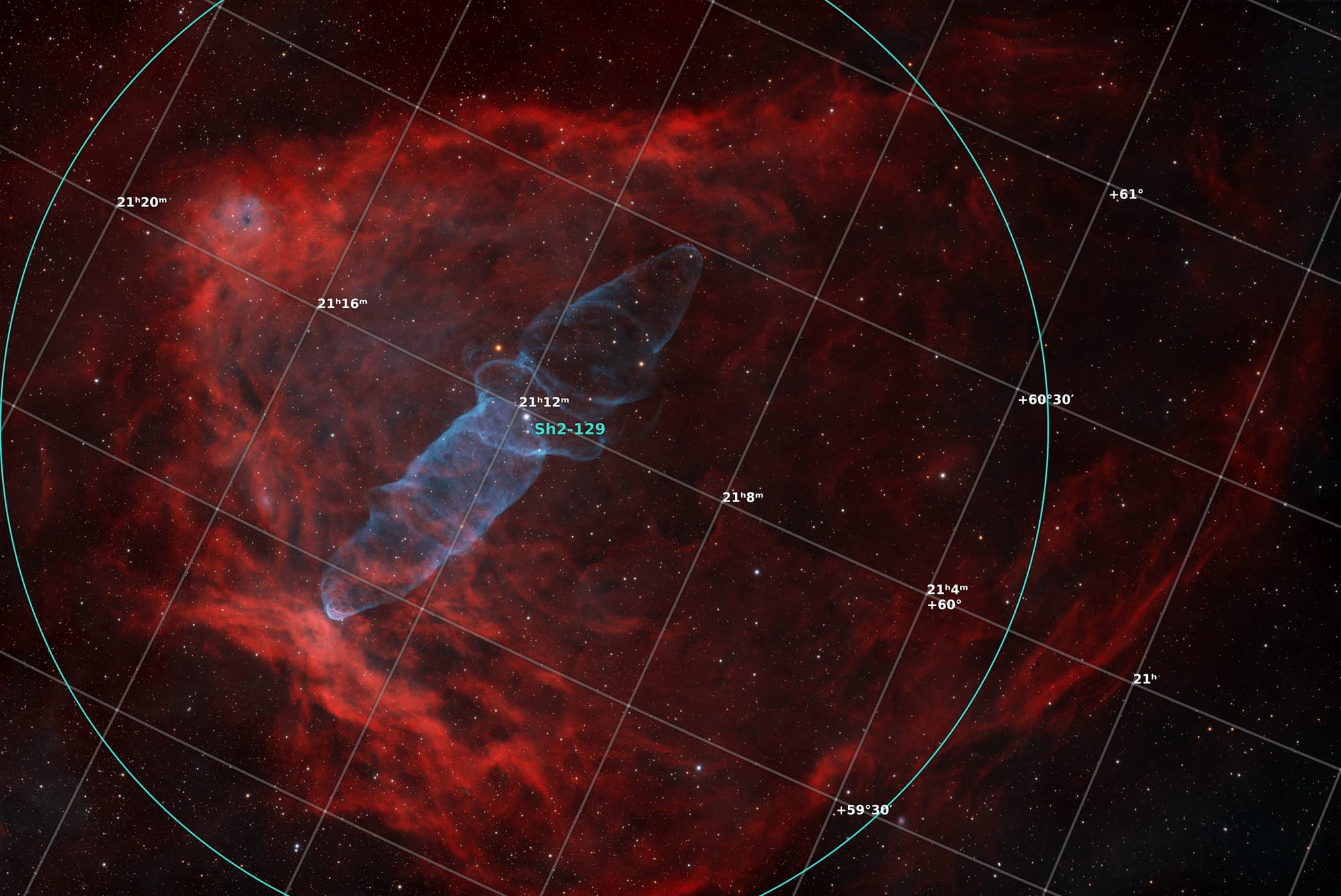
The red structure filling the frame is Sh2-129, an emission nebula in Cepheus about 2,300 light-years away, nicknamed the Flying Bat for the curved wings of hydrogen sweeping out from the brighter ridge in the lower left. In this HOO rendering the hydrogen glows deep crimson, and you can trace filament after filament curling through the wings, the whole shell has the look of slow-motion smoke lit from within. Between the wings, the field goes genuinely dark: those star-poor patches aren't empty sky but foreground Cepheus dust doing its quiet censoring.
And then there's the Squid. OU4 cuts diagonally across the bat's body as a translucent blue apparition, two tapered lobes pinched at a bright waist near the center of the frame. For years after its discovery astronomers debated whether it was a foreground planetary nebula that just happened to line up with Sh2-129, but the current best evidence puts it physically inside the bat - a giant bipolar outflow launched by the hot triple-star system HR 8119 sitting at its waist. If that association holds, the Squid stretches roughly 50 light-years tip to tip, making it one of the largest structures of its kind known.
The Squid Itself
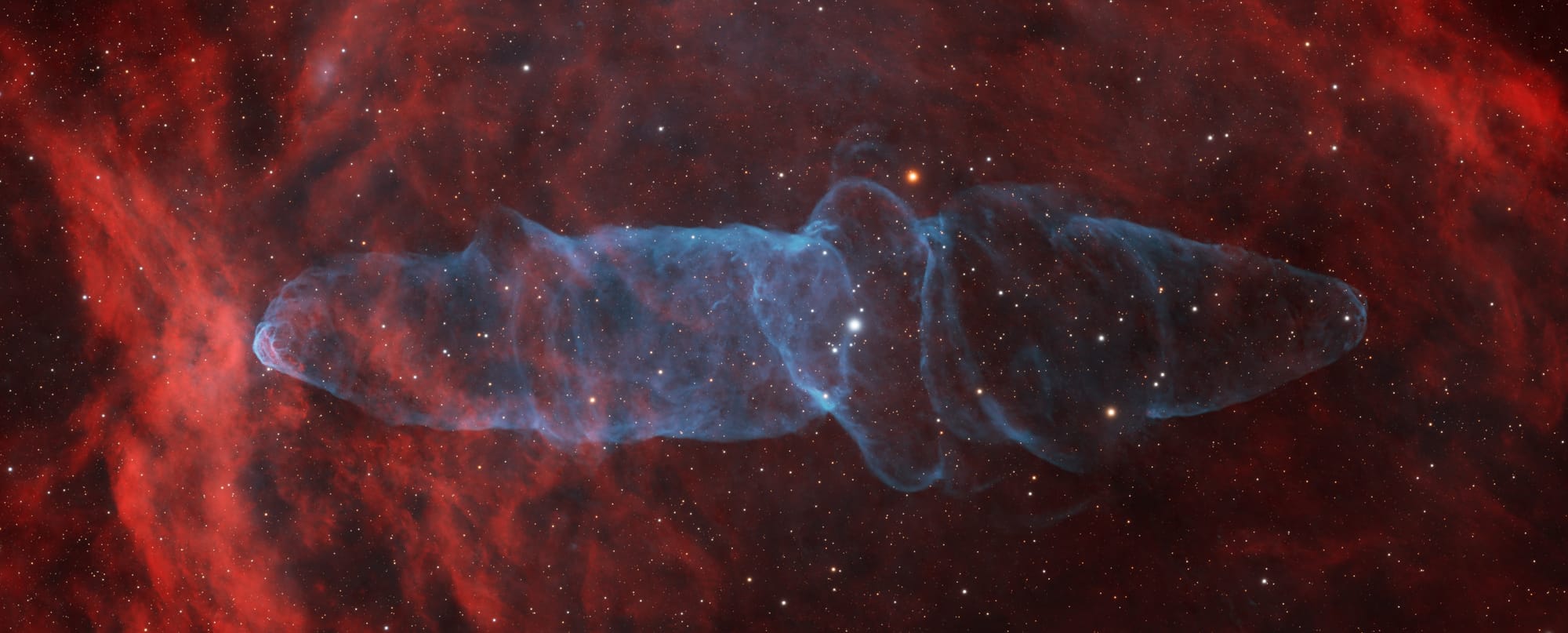
The Squid shines almost exclusively in doubly-ionized oxygen - in hydrogen light it's essentially invisible, which is exactly how it stayed hidden for so long. Look at the lobe edges: they aren't soft gradients but thin, sharply-bounded shells, nested one inside another like blown glass. Those are shock fronts - boundaries where fast gas driven off the central system slams into slower material and compresses it enough to glow. The upper lobe tapers to a smooth, bullet-shaped tip, while the lower lobe runs longer, lumpier, and visibly wrinkled, a hint that it's plowing into denser surroundings.
The Central Engine
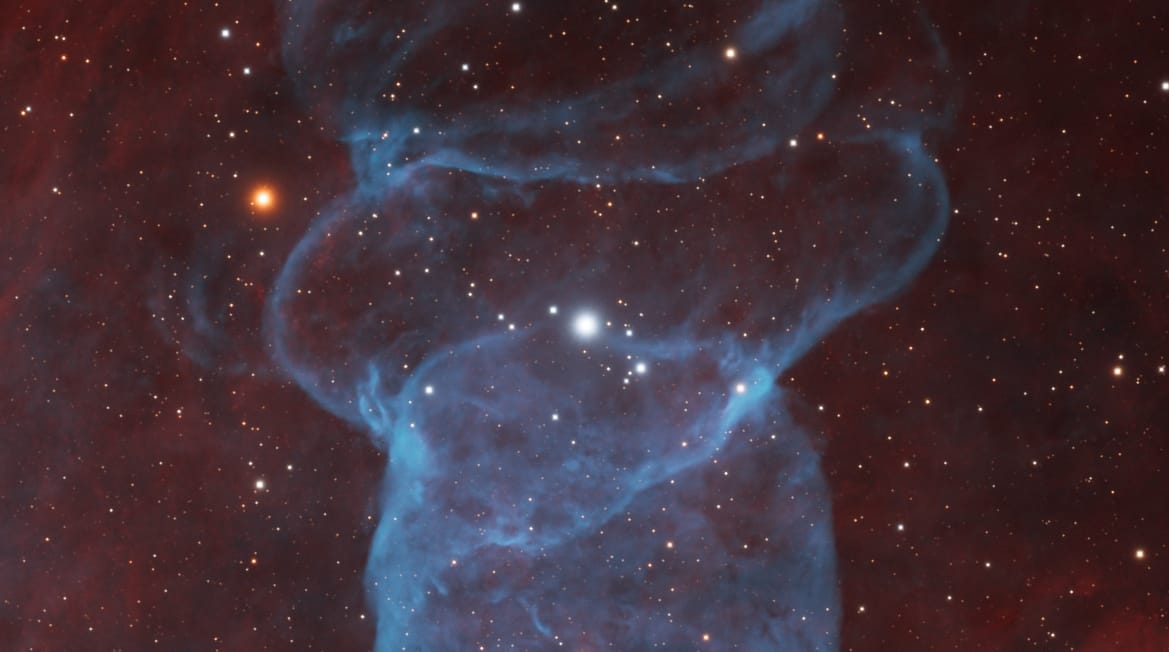
Here's this object's best story: the Squid wasn't found by a survey telescope or a space observatory. It was discovered in 2011 by French amateur astrophotographer Nicolas Outters, shooting Sh2-129 through an OIII filter - the "OU" in OU4 is literally his name. An object dozens of light-years across, hiding inside a well-photographed nebula, and it took an amateur with a narrowband filter and patience to notice it. In this crop you can see why the waist matters: the lobes converge on the bright star at center, the suspected source, and the overlapping shell edges here form the most intricate structure anywhere in the outflow, with faint blue wisps spilling sideways from the pinch point, perpendicular to the main axis.
Where the Squid Meets the Bat
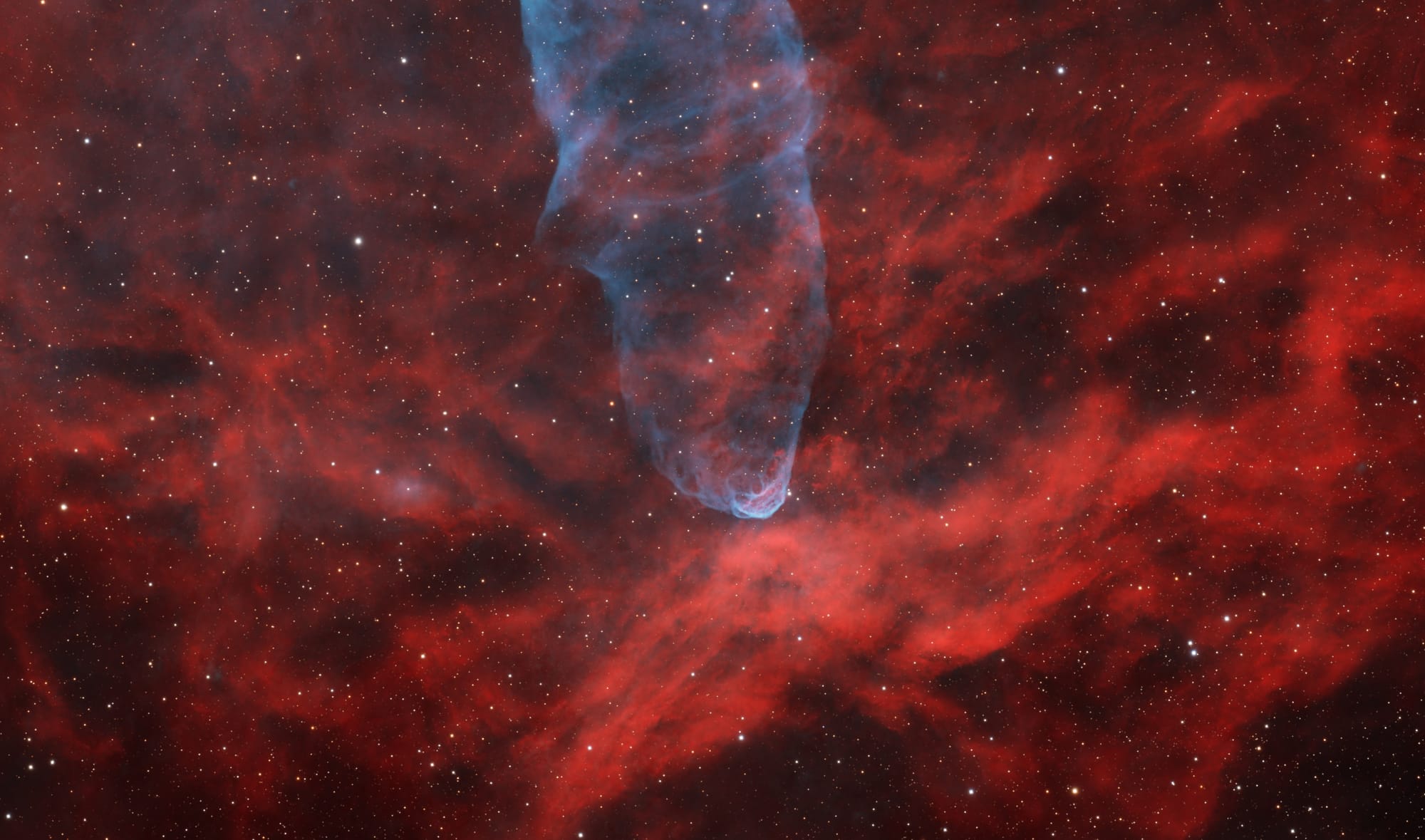
The lower tip of the Squid lands almost exactly on the brightest hydrogen ridge in the entire bat - and that's part of the evidence the two objects really do share the same space. The tip appears compressed and slightly brightened right where it meets the ridge, consistent with the outflow running into the denser wall of the surrounding HII region rather than merely passing in front of it or behind it. It's physics you can see directly in the frame: two structures with wildly different temperatures and chemistry, negotiating a boundary.
Finding It
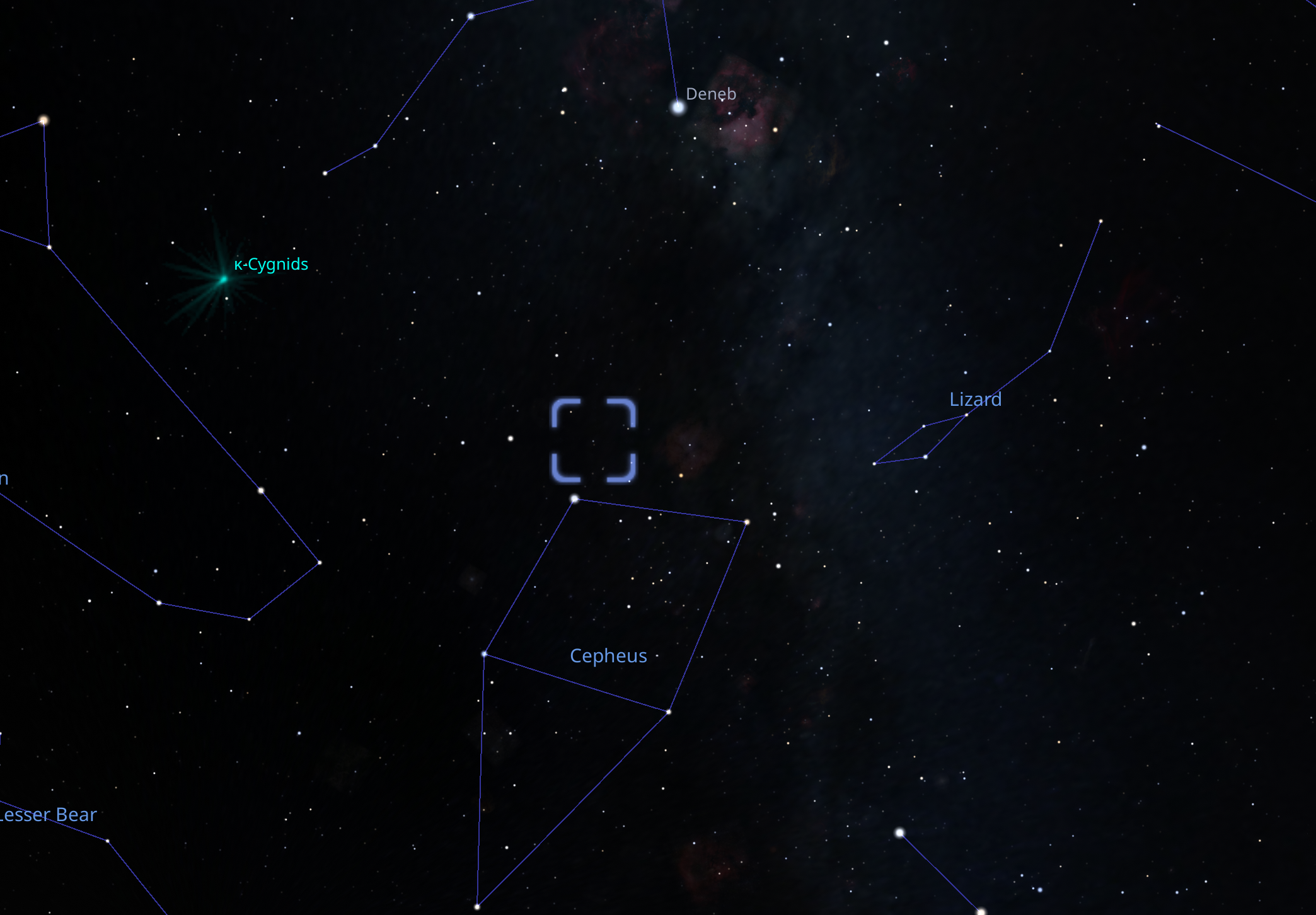
Sh2-129 sits at roughly RA 21h 11m, Dec +59° 57′, in Cepheus near the Cygnus border. The easiest hop: find Herschel's Garnet Star (μ Cephei), the strikingly red naked-eye star that marks IC 1396, then slide about four degrees west - the bat's wings fill that patch of sky. From Starfront's latitude of ~31.5°N it transits at a comfortable ~61° altitude and barely dips below the horizon at all, but it rides highest on summer and early-autumn evenings, so July through October is prime time. Visually, don't bother - this is a photographic object through and through, and the Squid demands serious OIII integration even under Bortle 1 skies.
Acquisition Details
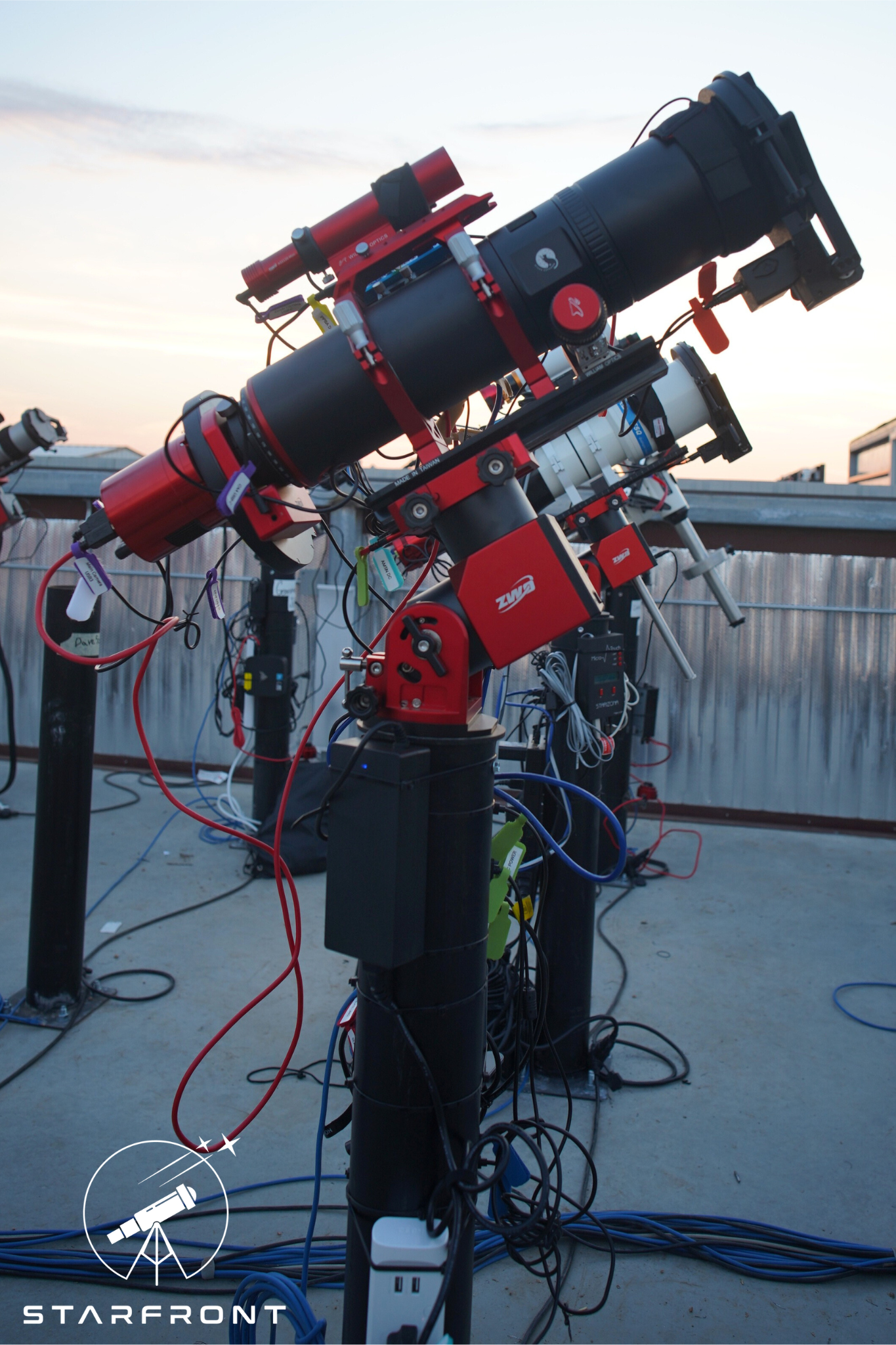
| Filter | Exposure | Subs |
|---|---|---|
| Ha | 300s | 183 |
| OIII | 600s | 240 |
| Red | 30s | 60 |
| Green | 30s | 60 |
| Blue | 30s | 60 |
| Equipment Type | Equipment |
|---|---|
| Telescope | Redcat 91 |
| Imaging Camera | ZWO ASI2600MM Pro |
| Mount | ZWO AM5N |
| Filters | Antlia 3nm (H,O), Antlia V Pro R, G, B |
| Accessories | ZWO CCA, ZWO EFW (7x2"), ZWO EAF, DeepSkyDad FP2 |
| Capture Software | N.I.N.A. |
| Processing Software | Pixinsight, RC Astro, SetiAstro |
⭐ RGB Stars
🌌 Starless nebula