
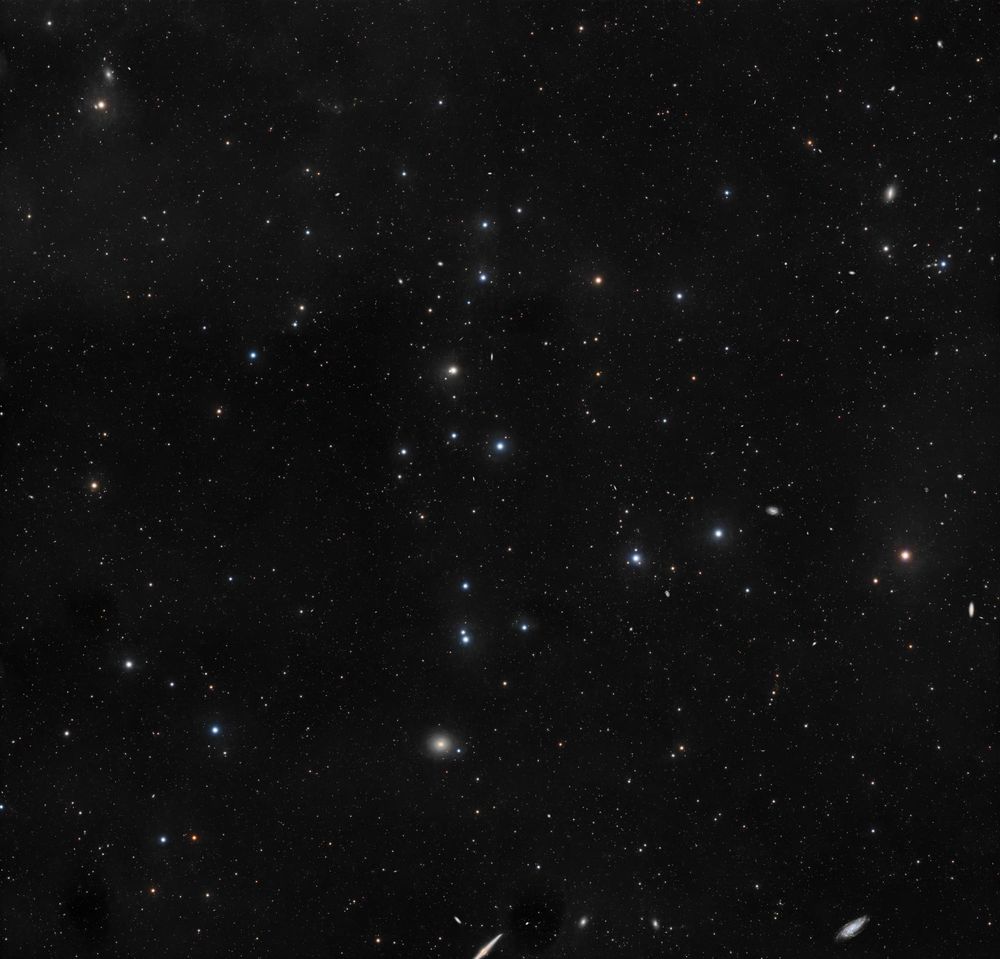
Nearly two thousand years before anyone pointed a telescope at it, this scattering of blue-white stars was already famous, as a haircut. The Coma Star Cluster, Melotte 111, is the sacrificed hair of Queen Berenice II of Egypt, making Coma Berenices the only constellation in the modern sky named after a real historical person. At roughly 290 light-years it's one of the closest star clusters to Earth, and it's quietly falling apart: surveys keep finding fewer low-mass stars than a cluster this age should have, stripped away over 450 million years of orbiting the galaxy.
A single frame from the RedCat 91 covers about 3° × 2° of sky, generous by any standard, and still not enough for this target. The cluster sprawls across nearly five degrees, so this image is a six-panel mosaic, 24½ hours of LRGB. The bonus of all that real estate: this field sits almost directly at the Milky Way's north galactic pole, where we look straight up out of our own galaxy's disk. With almost no foreground dust in the way, the frame is littered with galaxies, including one of the finest edge-on spirals in the sky.
The Field
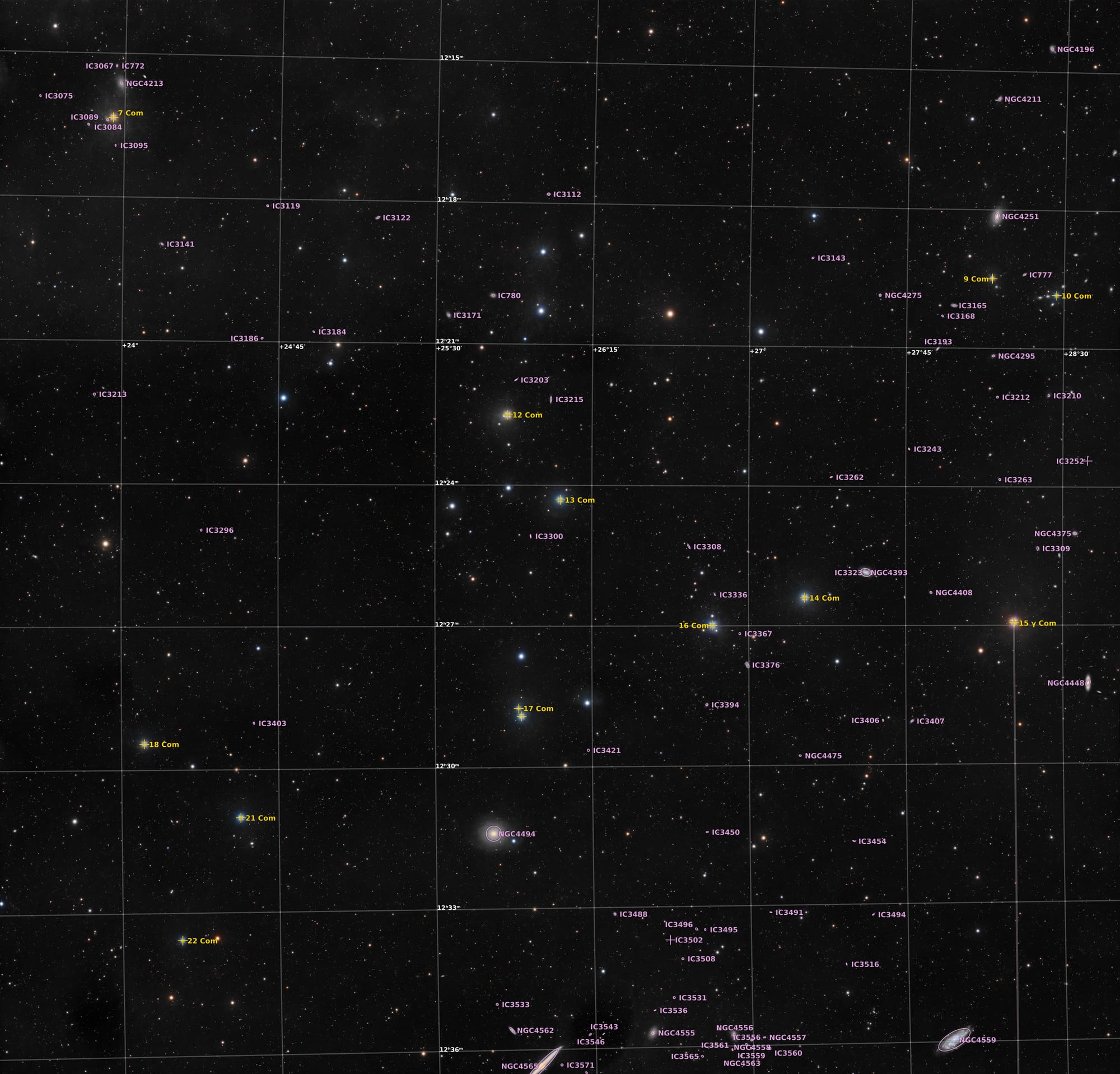
The cluster itself owns the middle of the frame: a loose lattice of blue-white stars, most of them genuine siblings born from the same cloud about 450 million years ago. Unlike the Pleiades, there's no nebulosity left here - the gas is long gone, and what remains is around forty bright members drifting through space together, so close to us that they refuse to fit in an ordinary telescope's field of view. To the naked eye under a dark sky they're a shimmering smudge; in binoculars they fill the view completely. The warm golden star near the cluster's heart is 12 Com, its brightest true member - the star everyone assumes is the leader, Gamma Comae, anchors the right edge of this framing (north is to the right here), and it turns out to be a fraud. More on that below.
Look past the stars and the frame gets busy. Sliding in at the bottom edge is the unmistakable sliver of NGC 4565, the Needle Galaxy, with the softly glowing elliptical NGC 4494 above it. The upper left corner holds a small crowd of its own - NGC 4213 surrounded by a swarm of faint IC galaxies near the star 7 Com — and the handsome inclined spiral NGC 4559 sits in the lower right corner. Beyond the named objects, the plate solve tags dozens more NGC and IC systems scattered across the field: members and neighbors of the Coma I galaxy group, plus far more distant systems shining through the galaxy's dust-free polar window.
The Needle Galaxy - NGC 4565
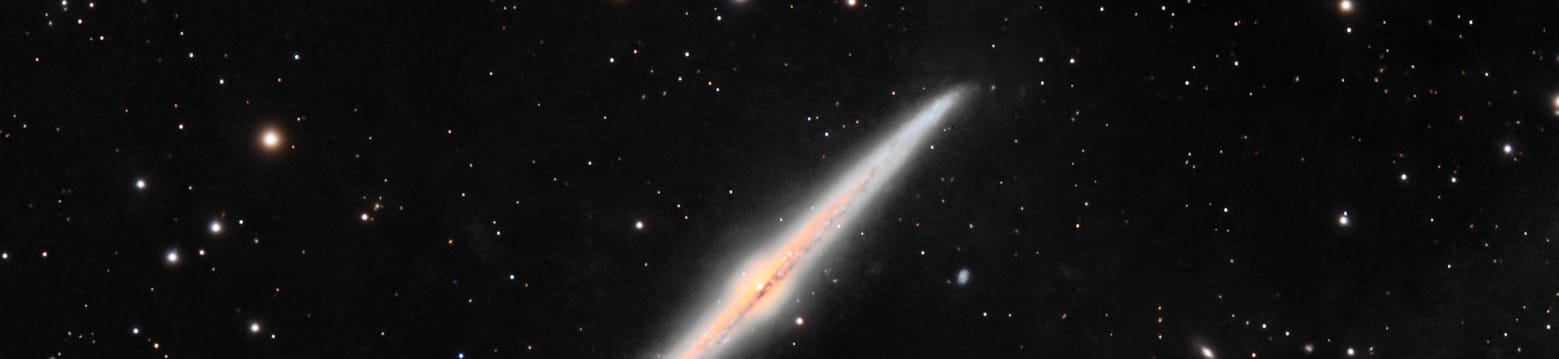
NGC 4565 is what happens when geometry does you a favor: a large spiral galaxy tilted almost exactly edge-on to our line of sight, compressing a hundred-thousand-light-year disk into a bright needle. Even at this mosaic's wide scale you can see the two things that make it a legend; the thin dark dust lane slicing lengthwise through the disk, and the bulge swelling at the center like a bead on a wire. Many astronomers suspect this is close to what the Milky Way would look like from outside. The cluster stars in front of it are about 290 light-years away; the Needle is around 40 million. Every star you can resolve in this image is foreground - the galaxy is roughly 140,000 times farther behind them.
The Golden Impostor - Gamma Comae
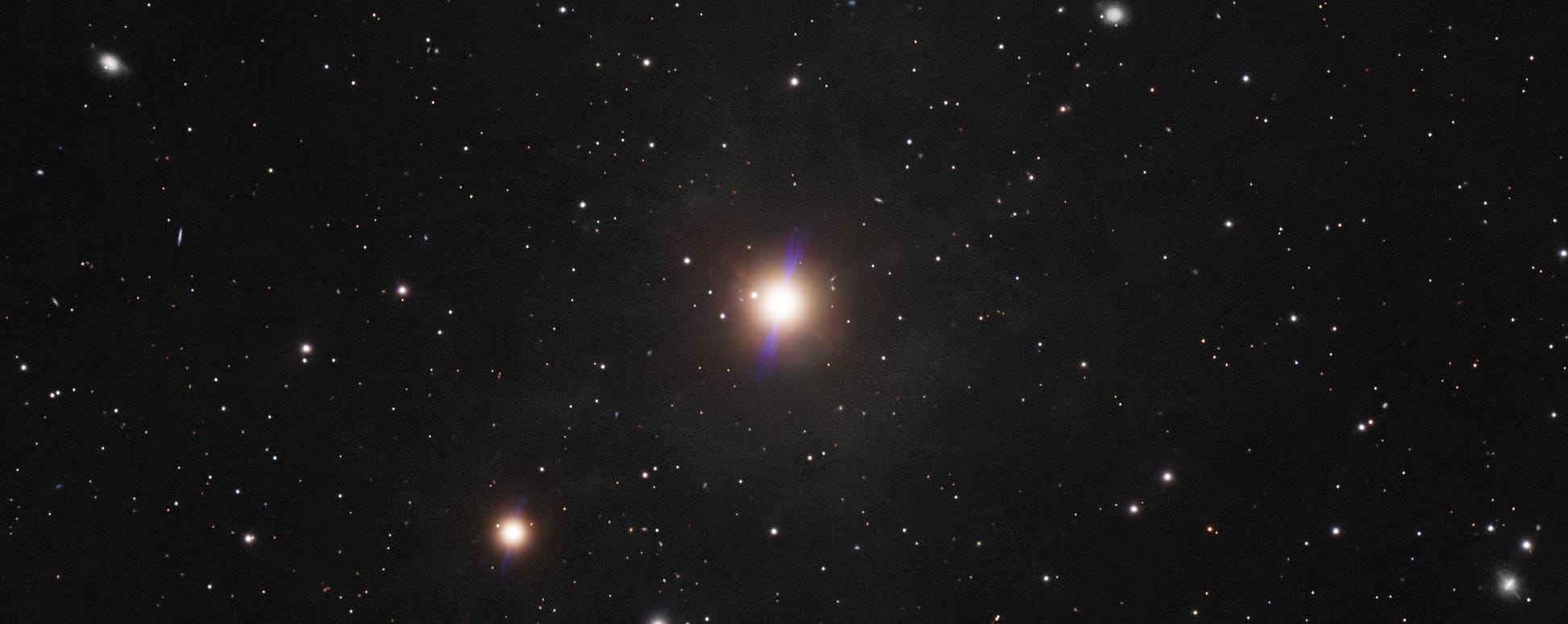
The star that lends the cluster its naked-eye sparkle is a fraud. Gamma Comae - the golden beacon at the northern edge of this frame, with the edge-on galaxy NGC 4448 hanging just below it - is an orange giant only about 170 light-years away, a foreground bystander photobombing from more than a hundred light-years in front of the cluster. The brightest true member is 12 Com, the golden star near frame center. And here's the quirky part: this cluster hid in plain sight for millennia. Everyone from Ptolemy onward could see the stars (he called them the tuft at the end of Leo's tail), but it wasn't confirmed as a genuine cluster - stars actually moving through space together - until astronomers measured their common proper motion in 1938. One of the nearest clusters in the sky was the last of the bright ones to be proven real.
The Coma I Group — NGC 4494 and NGC 4559
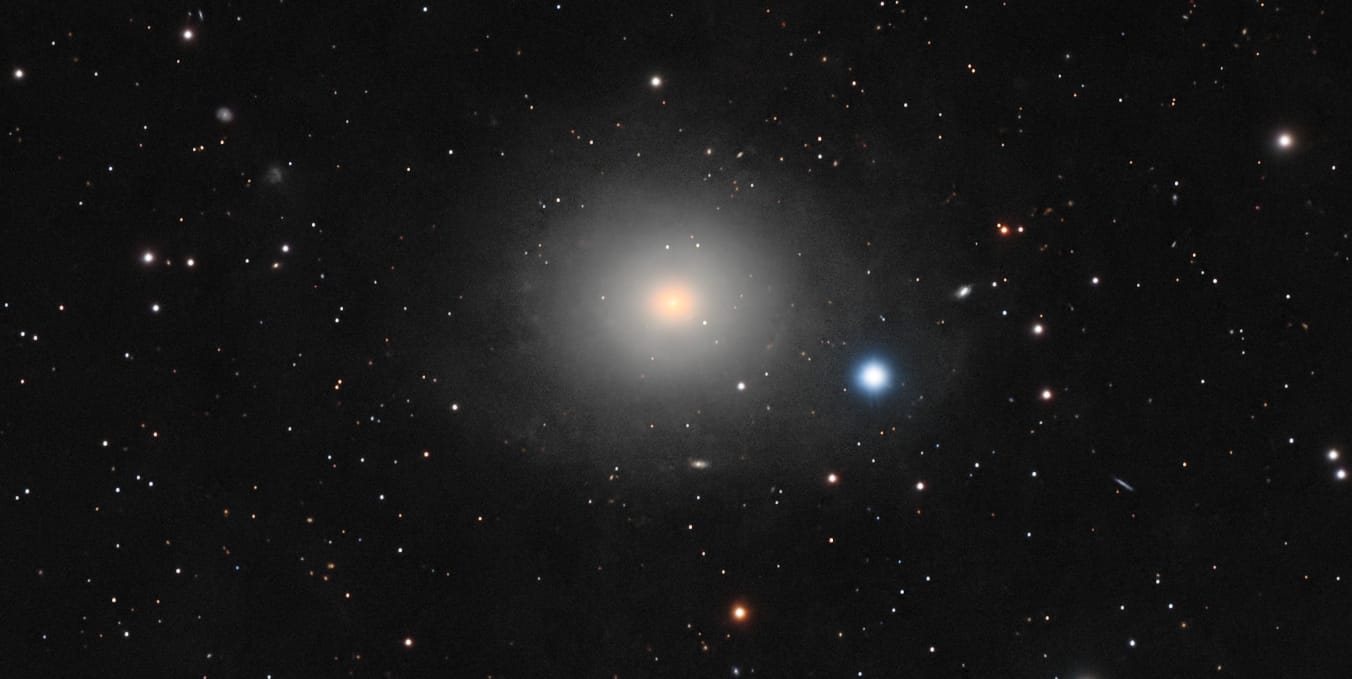
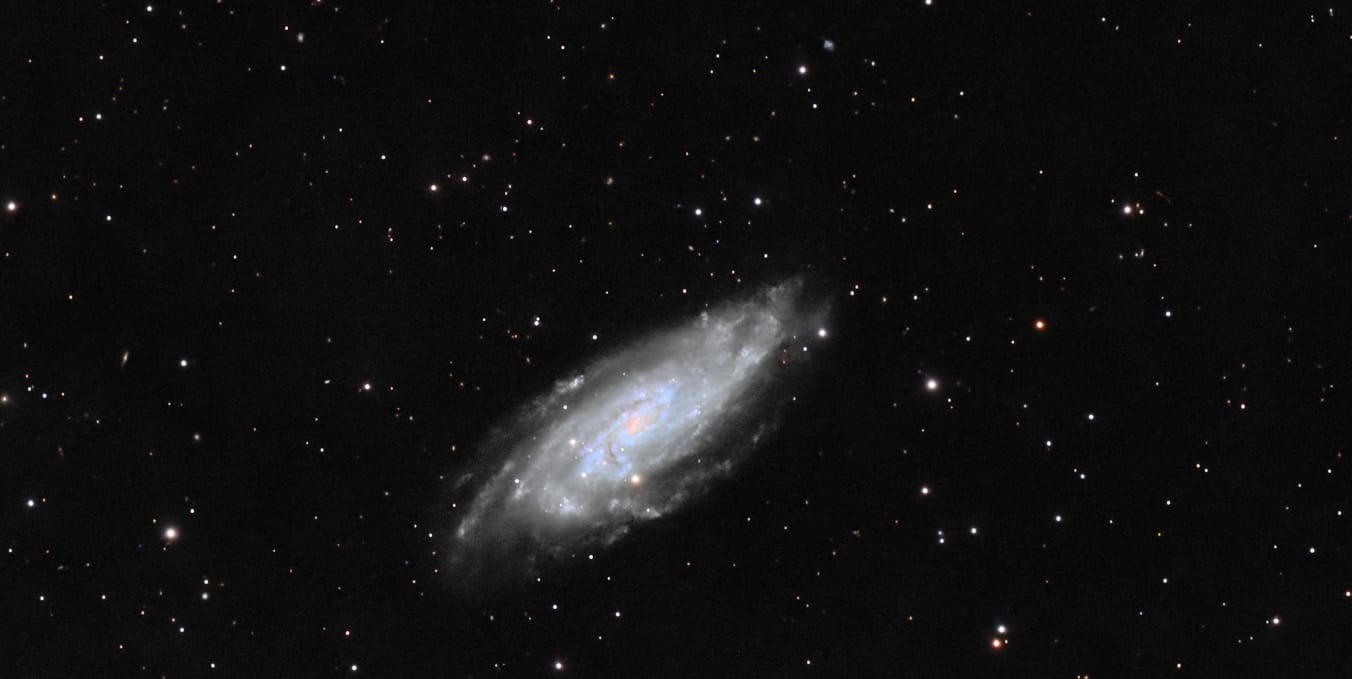
Two faces of the Coma I group: the smooth elliptical NGC 4494 and the ragged spiral NGC 4559 - LRGB
The brighter galaxies in this field belong mostly to the Coma I group, a loose gathering 30-50 million light-years out. NGC 4494 is the smooth glow below the cluster center - famous among astronomers because studies of its outskirts found surprisingly little evidence of dark matter, a result that's still argued about. Its stylistic opposite sits in the lower right corner: NGC 4559, a loose-limbed spiral tipped toward us, its arms flecked with blue star-forming knots. And they have plenty of company - the annotated plate solve tags over sixty NGC and IC galaxies in this one frame, from the NGC 4213 crowd huddled near 7 Com in the upper left to the swarm of faint smudges around the Needle at the bottom. Point a camera straight out of the galaxy's disk and this is what you get.
Finding It
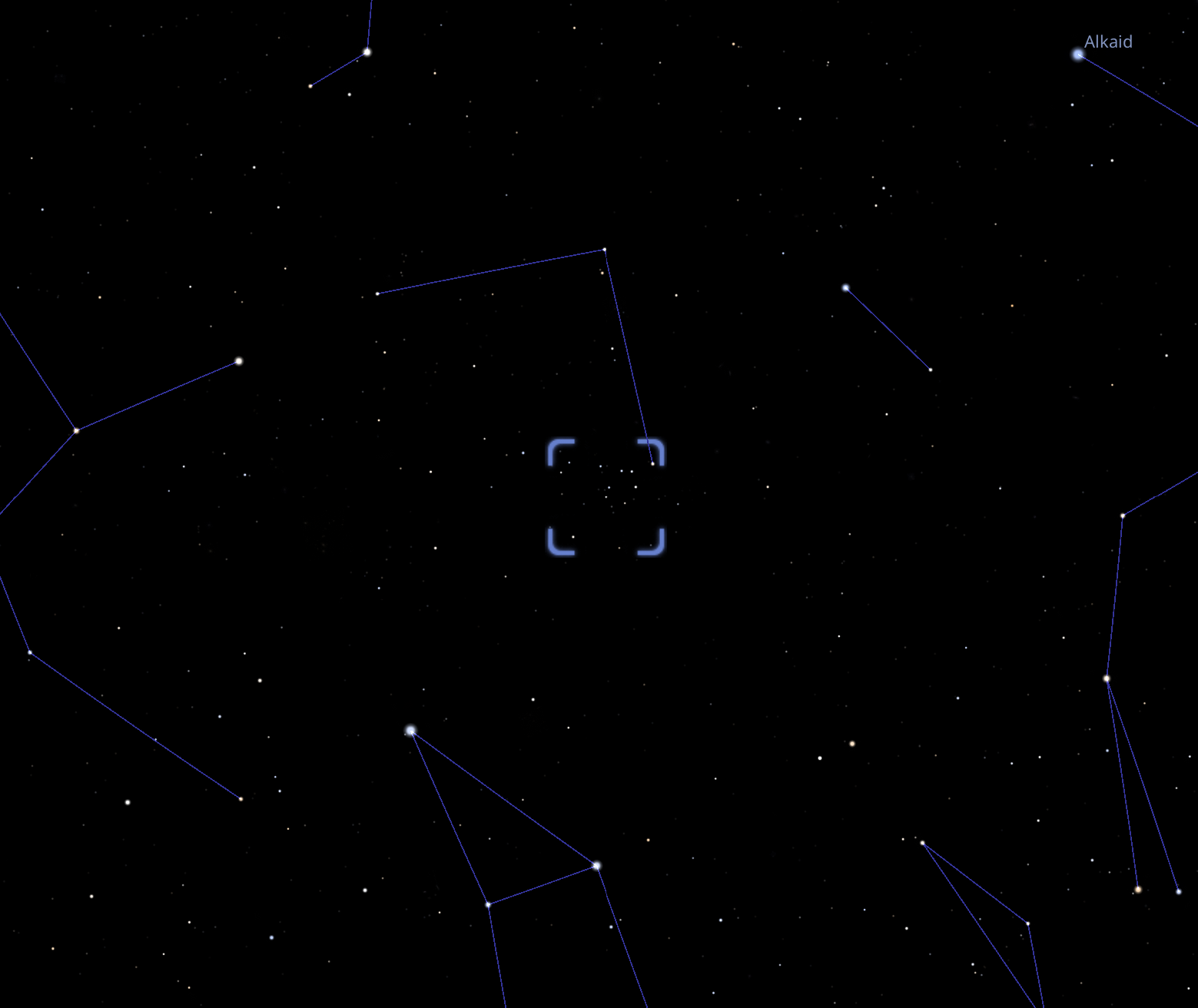
The Coma Star Cluster sits at roughly RA 12h 25m, Dec +26°, in Coma Berenices. Draw a line from Denebola, the star at the tip of Leo's tail, to Cor Caroli under the handle of the Big Dipper - the cluster lies almost exactly at the midpoint, an unmistakable naked-eye glow from a dark site. Spring is its season: it rides highest on April and May evenings - essentially straight overhead, through the least atmosphere possible.
Acquisition Details
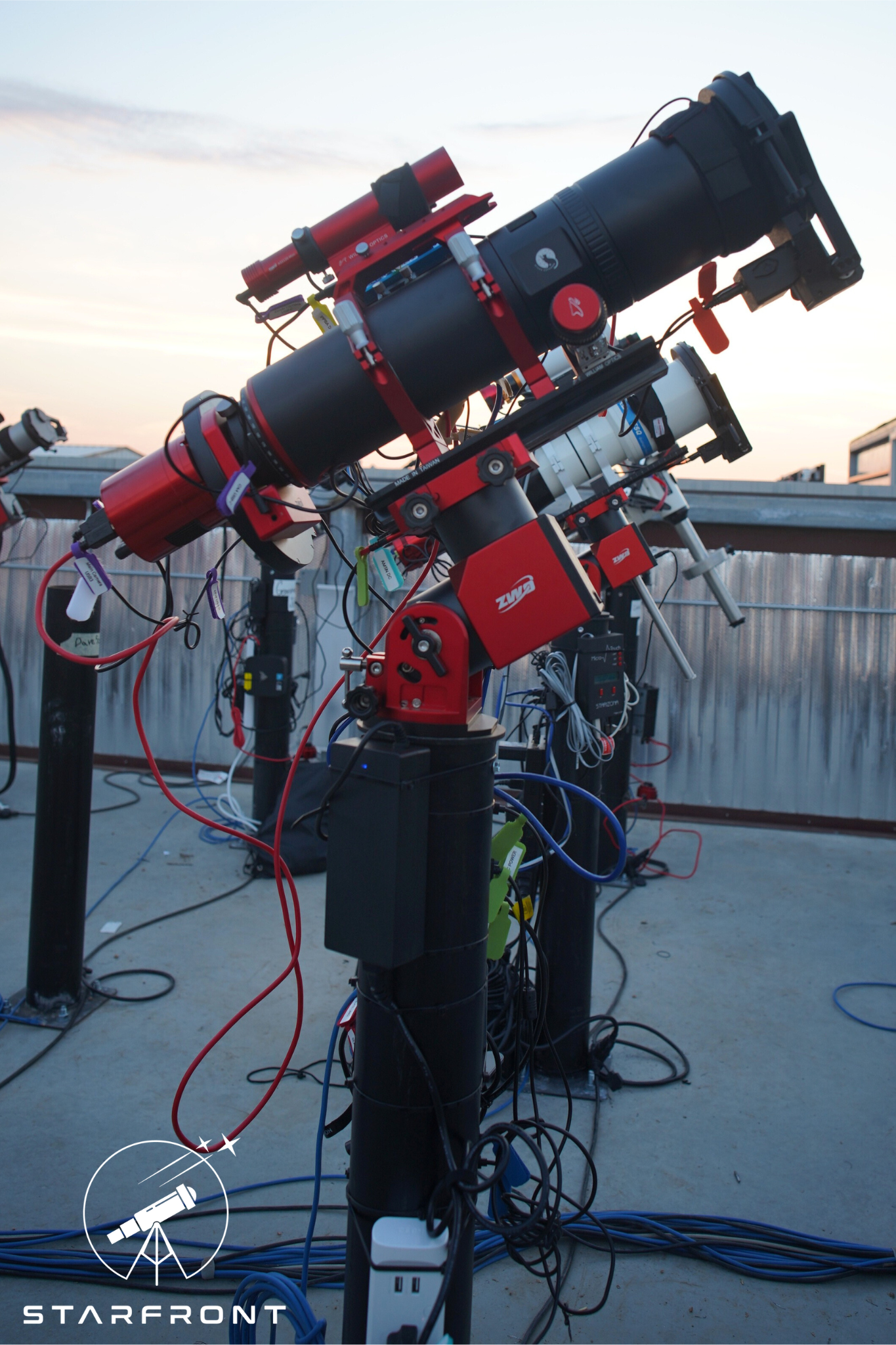
| Filter | Exposure | Subs |
|---|---|---|
| Red | 90s | 150 |
| Green | 90s | 150 |
| Blue | 120s | 150 |
| Lum | 120s | 360 |
| Equipment Type | Equipment |
|---|---|
| Telescope | Redcat 91 |
| Imaging Camera | ZWO ASI2600MM Pro |
| Mount | ZWO AM5N |
| Filters | Antlia V-Series LRGB Pro |
| Accessories | ZWO CCA, ZWO EFW (7x2"), ZWO EAF, DeepSkyDad FP2 |
| Capture Software | N.I.N.A. |
| Processing Software | Pixinsight, RC Astro, SetiAstro |
⭐ Stars
🌌 Starless
